


What is Ophthalmic Modular OT With Laminar Airflow?
INTRODUCTION
An Ophthalmic Modular OT With Laminar Airflow is a specially engineered operation theatre designed for ophthalmic surgical procedures while incorporating controlled, unidirectional airflow and filtration to support a clean and controlled surgical environment. Unlike a conventional operation theatre, it combines modular construction with specialized HVAC, HEPA filtration, airflow management, medical utilities, surgical lighting, electrical systems, and contamination-control features. This type of OT is designed around the specific requirements of eye surgeries, where precision, environmental control, equipment accessibility, and efficient workflow are important considerations.
Ophthalmic procedures may include cataract surgery, corneal procedures, glaucoma surgery, retinal procedures, and other microsurgical interventions. Because these procedures involve delicate tissues and specialized instruments, the operating environment needs to be carefully planned. A professionally engineered modular OT can provide a standardized, maintainable, and adaptable environment for modern ophthalmic surgery.
What Does Ophthalmic Modular OT Mean?
An ophthalmic modular operation theatre is a prefabricated or panel-based surgical environment specifically planned for eye-care procedures.
The modular approach generally uses factory-manufactured panels and coordinated engineering systems to create controlled interior spaces. Depending on the project requirements, the OT may incorporate:
- Modular wall and ceiling panels
- Hygienic flooring
- Hermetically sealed doors
- HVAC systems
- HEPA filtration
- Laminar airflow systems
- Medical gas pipelines
- Electrical distribution
- Surgical lighting
- Operating microscope provisions
- Environmental monitoring
- Equipment integration
The objective is to create a cleanable, durable, and efficiently organized surgical space.
What Is Laminar Airflow?
Laminar airflow refers to a controlled airflow pattern in which filtered air moves in a generally uniform, unidirectional manner across a defined area.
In healthcare and cleanroom applications, HEPA filtration is commonly used to reduce airborne particulate contamination in the supplied air. The airflow arrangement, filter location, velocity, room pressure, and air-change strategy need to be engineered according to the application.
Laminar airflow should not be considered a standalone guarantee of sterility. Rather, it is one component of a broader environmental and infection-control strategy that also includes room construction, HVAC design, cleaning practices, personnel control, equipment maintenance, and appropriate surgical protocols.
How Does an Ophthalmic Modular OT With Laminar Airflow Work?
The system typically combines several engineering elements.
Filtered air is supplied through appropriately positioned HEPA filtration and airflow components. The designed airflow pattern helps manage airborne particles within the controlled surgical area.
The overall system can include:
- Air-handling equipment
- Pre-filtration
- HEPA filtration
- Air distribution components
- Supply and return arrangements
- Pressure-control systems
- Temperature and humidity control
- Environmental monitoring
The exact configuration depends on the room size, surgical procedures, equipment layout, applicable standards, and the hospital's engineering requirements.
Why Is Laminar Airflow Used in Ophthalmic OTs?
Ophthalmic surgery requires a controlled environment because airborne particles can be undesirable in surgical areas.
Laminar airflow can help support:
- Controlled air movement
- Reduction of airborne particulate load
- Consistent filtered-air delivery
- Improved environmental control
- A cleaner surgical workspace
However, the benefits depend on proper design, installation, balancing, validation, operation, and maintenance.
Healthcare facilities should therefore assess laminar airflow as part of the complete OT ventilation strategy rather than evaluating it independently.
Role of HEPA Filtration
HEPA filtration is an important part of many controlled-air systems.
A properly selected and installed HEPA filter can remove a high proportion of airborne particles from the air passing through it. However, filter performance alone does not determine the cleanliness of an operating theatre.
A complete system should consider:
- Filter efficiency
- Filter housing
- Sealing
- Filter integrity
- Airflow distribution
- Pressure differential
- Filter loading
- Maintenance
- Replacement schedules
HEPA filter integrity and airflow performance should be tested during commissioning and periodically according to the facility's quality and maintenance program.
Modular Construction of the Ophthalmic OT
Modular construction provides several advantages for healthcare facilities.
The walls and ceilings can be designed using specialized panels with smooth, sealed, and cleanable surfaces. The exact material may vary according to project requirements.
Common considerations include:
- Smooth surfaces
- Minimal joints
- Sealed connections
- Easy cleaning
- Moisture resistance
- Durability
- Maintenance accessibility
Modular construction can also make future modifications easier compared with some conventional construction approaches.
Importance of HVAC Integration
HVAC is one of the most important systems in an ophthalmic modular OT.
The HVAC system should be engineered to manage:
- Temperature
- Humidity
- Fresh air
- Air changes
- Pressure relationships
- Filtration
- Air distribution
- Heat loads from equipment
Operating theatres generally require controlled ventilation and positive-pressure relationships to surrounding less-clean areas where applicable.
The HVAC design should also account for heat generated by surgical lights, operating microscopes, monitors, medical equipment, and personnel.
Temperature and Humidity Control
Stable environmental conditions are important for patient and staff comfort as well as equipment operation.
The HVAC system should provide suitable control of:
- Room temperature
- Relative humidity
- Fresh-air supply
- Air movement
The exact operating range should be established according to the applicable healthcare engineering requirements, local regulations, equipment specifications, and hospital policies.
Continuous environmental monitoring can help identify deviations before they affect operations.
Surgical Lighting Requirements
Ophthalmic surgery requires specialized lighting because surgeons frequently work with microscopes and fine anatomical structures.
The OT may include:
- LED surgical lights
- Adjustable ambient lighting
- Examination lighting
- Emergency lighting
- Microscope-compatible lighting arrangements
Lighting should minimize glare and unwanted shadows while allowing surgeons to maintain appropriate visual conditions.
Lighting controls can also allow ambient illumination to be adjusted according to the procedure.
Operating Microscope Integration
The operating microscope is central to many ophthalmic procedures.
The OT layout should therefore consider:
- Microscope position
- Ceiling clearance
- Surgeon access
- Patient positioning
- Assistant access
- Electrical supply
- Equipment movement
- Lighting interaction
Ceiling-mounted microscope systems may require careful coordination between structural supports, HVAC, electrical services, lighting, and modular ceiling panels.
Proper planning avoids conflicts between major pieces of equipment.
Medical Gas and Utility Planning
Modern ophthalmic operation theatres require reliable utility infrastructure.
Depending on the procedure and hospital requirements, utilities may include:
- Oxygen
- Medical air
- Vacuum
- Electrical outlets
- Data connections
- Emergency power
- Communication systems
Utility outlets should be positioned according to the surgical workflow and equipment requirements.
A coordinated utility layout reduces cable congestion and improves accessibility.
Electrical and Backup Power Systems
Reliable electrical infrastructure is essential for ophthalmic surgery.
The design should consider:
- Dedicated circuits
- Essential electrical supply
- UPS systems
- Emergency power
- Equipment grounding
- Surgical equipment requirements
- Lighting backup
- Monitoring systems
Critical equipment should be connected to appropriately designed backup systems according to hospital electrical engineering requirements.
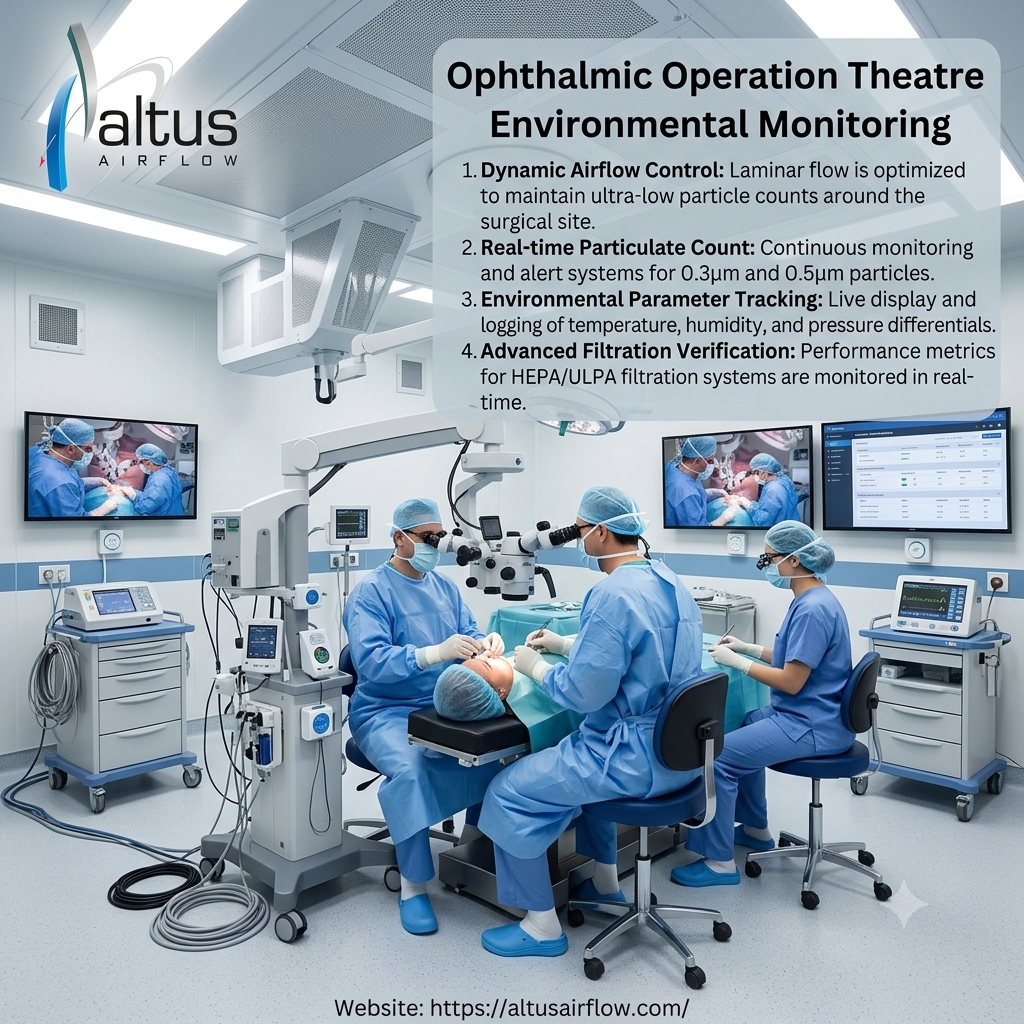
Environmental Monitoring
An advanced OT can incorporate environmental monitoring systems to track important parameters.
Monitoring may include:
- Temperature
- Relative humidity
- Pressure differential
- Airflow
- Filter condition
- Particle levels where required
Alarm systems can notify staff when monitored parameters move outside established limits.
Monitoring records can also support maintenance, quality assurance, and facility management.
Infection-Control Considerations
The purpose of modular construction and controlled airflow is to support infection-control objectives, but they do not replace clinical infection-prevention practices.
A comprehensive approach should include:
- Appropriate ventilation
- HEPA filtration
- Controlled airflow
- Positive pressure where required
- Cleanable surfaces
- Proper cleaning protocols
- Restricted access
- Equipment hygiene
- Preventive maintenance
- Regular environmental testing
Healthcare teams should follow their applicable infection-prevention policies and clinical protocols.
Advantages of Ophthalmic Modular OT With Laminar Airflow
A properly engineered system can offer several operational advantages.
Controlled Environment
The combination of modular construction and engineered ventilation helps establish a controlled surgical environment.
Improved Workflow
Equipment, utilities, lighting, and work areas can be planned around ophthalmic procedures.
Easier Maintenance
Smooth modular surfaces and accessible engineering systems can simplify cleaning and maintenance.
Equipment Integration
Operating microscopes, surgical tables, lights, monitors, and other equipment can be incorporated into the initial design.
Scalability
Modular systems can provide greater flexibility when future modifications or upgrades are required.
Consistent Performance
Properly tested HVAC and airflow systems can provide predictable environmental performance when maintained correctly.
What Should Hospitals Consider Before Installation?
Hospitals should conduct a detailed assessment before selecting and installing the system.
Important considerations include:
- OT dimensions
- Surgical procedures
- Equipment list
- Surgeon workflow
- Patient movement
- HVAC capacity
- Airflow configuration
- HEPA filtration
- Electrical load
- Medical gases
- Emergency power
- Monitoring requirements
- Applicable standards
- Validation requirements
- Maintenance access
The design should be developed through coordination between hospital administrators, surgeons, biomedical teams, facility engineers, infection-control personnel, architects, and the specialist OT provider.
Testing and Validation
Testing is essential before the OT becomes operational.
Depending on the system design, commissioning can include:
- HEPA filter integrity testing
- Airflow velocity testing
- Airflow visualization
- Air-change verification
- Pressure differential testing
- Temperature and humidity verification
- Particle counting
- HVAC performance testing
- Electrical testing
- Alarm verification
The final testing program should be based on the approved project specification and applicable healthcare and cleanroom requirements.
Maintenance Requirements
Regular maintenance is necessary to preserve system performance.
A maintenance program may include:
- HVAC inspection
- Filter monitoring
- HEPA filter replacement when required
- Airflow balancing
- Sensor calibration
- Pressure monitoring
- Electrical inspections
- Cleaning of accessible components
- Periodic performance testing
Maintenance records should be maintained so that facility teams can identify performance trends and schedule corrective actions.
How Is It Different From a Conventional OT?
A conventional OT may provide general surgical infrastructure, but an ophthalmic modular OT is specifically planned around the needs of eye surgery.
The difference can include:
- Procedure-specific layout
- Microscope integration
- Specialized lighting
- Controlled airflow
- Ophthalmic equipment coordination
- Modular cleanable construction
- Specialized utility planning
- Environmental monitoring
This specialty-focused approach can improve workflow and support the operational requirements of modern ophthalmic surgery.
Conclusion
An Ophthalmic Modular OT With Laminar Airflow combines modular operation-theatre construction with engineered airflow and filtration systems to support a controlled environment for ophthalmic procedures. Its effectiveness depends on coordinated design of HVAC, HEPA filtration, airflow distribution, modular surfaces, surgical lighting, operating microscopes, medical utilities, electrical infrastructure, monitoring, testing, and maintenance. Laminar airflow should be viewed as one element of an overall contamination-control and ventilation strategy rather than as a guarantee of sterility.
For hospitals planning a specialized ophthalmic surgical environment, careful design and validation are essential to achieving reliable performance and efficient workflow. By working with an experienced healthcare engineering partner, hospitals can develop a modular OT that is adaptable, maintainable, and aligned with the operational needs of modern eye-care facilities. Altus Airflow provides specialized modular OT and controlled-environment solutions for healthcare facilities seeking professionally engineered ophthalmic operation-theatre infrastructure.
Frequently Asked Questions
1. What is an Ophthalmic Modular OT With Laminar Airflow?
An Ophthalmic Modular OT With Laminar Airflow is a specialized operation theatre combining modular construction, controlled HVAC, HEPA filtration, and engineered airflow to support a clean and controlled environment for ophthalmic surgery.
2. Why is laminar airflow used in an ophthalmic operation theatre?
An Ophthalmic Modular OT With Laminar Airflow uses controlled unidirectional airflow to help manage airborne particles and provide filtered air within the surgical environment as part of a broader contamination-control strategy.
3. What role does HEPA filtration play?
HEPA filtration in an Ophthalmic Modular OT With Laminar Airflow helps remove airborne particles from supplied air. Proper filter selection, installation, integrity testing, and maintenance are necessary for reliable performance.
4. Can an ophthalmic modular OT accommodate operating microscopes?
Yes. An Ophthalmic Modular OT With Laminar Airflow can be specifically planned to accommodate operating microscopes, surgical tables, lighting systems, monitors, and other ophthalmic equipment.
5. Does an Ophthalmic Modular OT With Laminar Airflow improve infection control?
An Ophthalmic Modular OT With Laminar Airflow can support infection-control objectives through controlled airflow, filtration, positive-pressure arrangements where required, and cleanable surfaces, but it does not replace clinical infection-prevention practices.
Read Our Previous Blog------>How can businesses choose the right Laminar Airflow System Manufacturers?
