


How can hospitals choose the right provider for an Ophthalmic Modular Operation Theatre?
INTRODUCTION
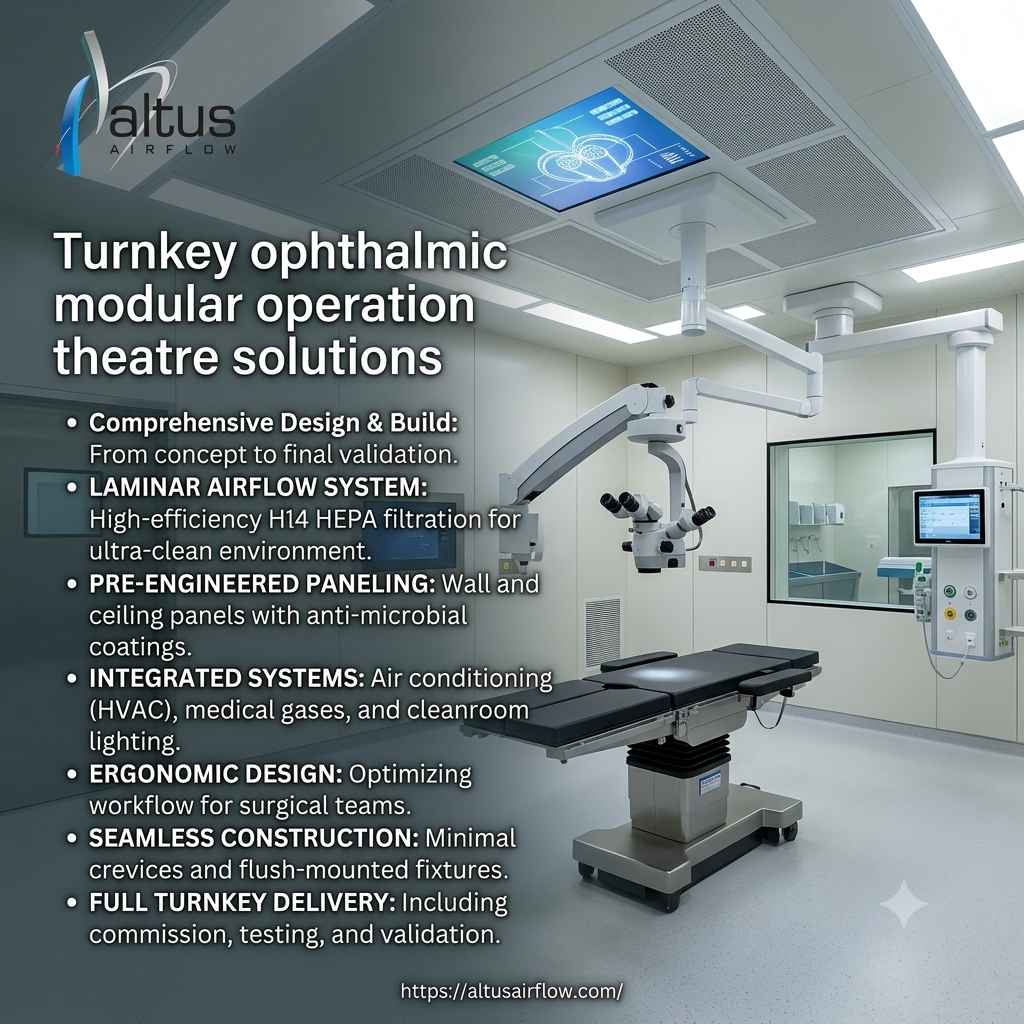
Selecting the right provider for an Ophthalmic Modular Operation Theatre is an important decision for hospitals and eye-care facilities planning a modern surgical environment. Ophthalmic procedures require precision, controlled environmental conditions, reliable infrastructure, and efficient equipment integration. The selected provider should therefore have expertise in modular OT construction, cleanroom engineering, HVAC systems, HEPA filtration, laminar airflow, medical gases, electrical infrastructure, testing, validation, and commissioning. Hospitals should evaluate technical capabilities, project experience, quality practices, customization options, after-sales support, and overall project management before selecting a provider.
Why Choosing the Right Provider Matters
An ophthalmic operation theatre is a specialized healthcare environment rather than a conventional construction space.
The provider must understand how different systems work together, including:
- Modular wall and ceiling systems
- HVAC infrastructure
- HEPA filtration
- Laminar airflow
- Positive pressure management
- Medical gas systems
- Electrical systems
- Surgical lighting
- Environmental monitoring
- Equipment integration
Choosing an experienced provider can help hospitals establish an environment that supports infection-control practices, surgical workflow, equipment performance, and long-term operational requirements.
Evaluate Experience in Ophthalmic Projects
One of the first factors hospitals should examine is relevant project experience.
A provider with experience in ophthalmic facilities is more likely to understand the specific requirements associated with eye surgery.
Hospitals should ask for evidence of experience with:
- Ophthalmic operation theatres
- Eye hospitals
- Specialty eye-care centers
- Day-care surgical facilities
- Multi-specialty hospitals
- Modular healthcare projects
Relevant project experience can help the provider anticipate common design and installation challenges.
Assess Technical and Engineering Expertise
A reliable provider should have multidisciplinary engineering capabilities.
These may include:
- Modular OT engineering
- HVAC engineering
- Cleanroom engineering
- Electrical engineering
- Medical gas planning
- Airflow engineering
- Environmental monitoring
- Testing and commissioning
A multidisciplinary approach helps ensure that the different technical systems are coordinated instead of being designed independently.
Review HVAC Design Capabilities
HVAC is one of the most important components of an ophthalmic OT.
The provider should understand how to design systems that address:
- Temperature
- Relative humidity
- Air changes
- Fresh-air requirements
- Filtration
- Air distribution
- Pressure relationships
The HVAC system should be designed according to the project's clinical requirements, room configuration, applicable standards, and engineering specifications.
Hospitals should ask providers how HVAC performance will be calculated, installed, balanced, tested, and maintained.
Examine HEPA Filtration Expertise
HEPA filtration supports airborne particulate control in controlled healthcare environments.
The provider should be able to explain:
- HEPA filter specifications
- Filter efficiency
- Filter housing design
- Sealing arrangements
- Filter pressure drop
- Maintenance requirements
- Integrity testing
Hospitals should also request appropriate filter documentation and testing records as part of project documentation.
Check Laminar Airflow Capabilities
Where laminar airflow is specified for the project, the provider should demonstrate experience in airflow design and integration.
Important considerations include:
- Airflow direction
- Airflow velocity
- Supply-air distribution
- Return-air positioning
- Surgical-zone coverage
- Equipment placement
- Turbulence control
A laminar airflow system should be designed together with the room layout because surgical lights, microscopes, equipment, and staff movement can influence airflow.
Evaluate Modular Construction Quality
The physical construction of the theatre should support hygiene, durability, and maintainability.
Hospitals should evaluate the proposed materials and construction methods for:
- Wall panels
- Ceiling systems
- Flooring
- Doors
- Sealed joints
- Service penetrations
- Fixtures
- Cleanable surfaces
Smooth, durable, and appropriately sealed surfaces can simplify cleaning and support infection-control procedures.
Review Equipment Integration
A provider should understand the infrastructure requirements of ophthalmic equipment.
Common equipment may include:
- Operating microscopes
- Phacoemulsification systems
- Surgical tables
- Surgical lights
- Patient monitoring systems
- Ophthalmic diagnostic equipment
The design should consider equipment positioning, electrical requirements, ceiling supports, data connections, accessibility, and workflow.
Early equipment coordination helps reduce modifications during installation.
Assess Customization Capabilities
Every hospital has different requirements.
The provider should be capable of developing customized solutions according to:
- Available room dimensions
- Surgical procedures
- Equipment requirements
- Number of operating rooms
- HVAC requirements
- Utility locations
- Future expansion plans
- Hospital workflow
A standardized design may not be suitable for every facility. Customization should be based on engineering and clinical requirements.
Check Validation and Testing Services
Testing and validation should be included in the project plan.
Depending on the project scope, testing may include:
- HEPA filter integrity testing
- Airflow velocity measurement
- Air-change verification
- Particle-count testing
- Pressure differential testing
- Temperature measurement
- Relative humidity measurement
- HVAC performance testing
- Electrical testing
Testing provides evidence that the completed installation performs according to the defined specifications.
Examine Commissioning Procedures
Commissioning is the stage where the installed systems are checked for operational performance.
A professional provider should establish a commissioning process covering:
- HVAC systems
- Airflow systems
- Electrical systems
- Medical gas systems
- Lighting
- Environmental monitoring
- Alarm systems
Hospitals should request commissioning documentation before accepting the completed facility.
Review Quality Management Practices
Quality management should be considered throughout the project.
Hospitals can evaluate:
- Quality-control procedures
- Material inspection
- Installation inspections
- Testing procedures
- Documentation
- Corrective-action processes
- Project supervision
Certifications such as ISO 9001 may provide evidence of a structured quality-management system, but hospitals should also assess actual project execution and product quality.
Verify Regulatory and Standards Awareness
The provider should understand the healthcare engineering requirements applicable to the project.
Depending on the facility and scope, considerations may include:
- Healthcare facility requirements
- Cleanroom principles
- HVAC requirements
- Infection-control practices
- Electrical safety
- Medical gas requirements
- Applicable national and international standards
Hospitals should ask providers to clearly identify the standards and specifications used during design and validation.
Consider Project Management Capabilities
Good engineering can still be affected by poor project management.
A reliable provider should have a structured process for:
- Site surveys
- Design approvals
- Procurement
- Material delivery
- Installation
- Coordination
- Testing
- Commissioning
- Documentation
A dedicated project manager can help coordinate communication between hospital representatives, engineers, contractors, equipment suppliers, and installation teams.
Evaluate Turnkey Project Capability
Hospitals may benefit from working with a provider capable of managing multiple project stages.
A turnkey approach may include:
- Site assessment
- Concept design
- Detailed engineering
- Procurement
- Modular construction
- HVAC installation
- Electrical and medical gas integration
- Equipment coordination
- Testing
- Commissioning
- Documentation
- Training
Having coordinated responsibility can reduce communication gaps between multiple contractors.
Check Material and Component Quality
Hospitals should request technical information about major components.
This may include:
- Modular panels
- HEPA filters
- HVAC equipment
- Doors
- Flooring
- Lighting
- Control systems
- Electrical components
- Medical gas accessories
The focus should be on suitability, durability, performance, serviceability, and compliance with project specifications.
Evaluate Energy Efficiency
Operating theatres require significant energy, particularly because HVAC systems may operate for long periods.
Providers should consider appropriate energy-efficiency measures such as:
- High-efficiency motors
- Variable-frequency drives
- Efficient air-handling units
- Smart controls
- Optimized airflow
- Energy monitoring
Energy efficiency should be balanced against clinical and environmental requirements.
Consider Maintenance and After-Sales Support
Long-term service is an important part of provider selection.
Hospitals should ask whether the provider offers:
- Preventive maintenance
- HVAC servicing
- HEPA filter replacement
- Airflow balancing
- Environmental testing
- Technical support
- Spare parts
- Emergency service
- Annual Maintenance Contracts
A strong after-sales program can help maintain system performance after project completion.
Assess Future Expansion Options
Hospitals may need to add equipment or expand surgical capacity later.
The provider should consider future requirements such as:
- Additional electrical capacity
- Additional data points
- HVAC expansion
- Equipment upgrades
- Utility modifications
- Monitoring-system expansion
Future-ready planning can reduce the need for major structural changes later.
Compare Providers Beyond Price
Cost is important, but it should not be the only selection criterion.
Hospitals should compare:
- Technical expertise
- Project experience
- Material quality
- Engineering capabilities
- Testing and validation
- Warranty
- Maintenance
- Energy efficiency
- Project timeline
- Documentation
- Long-term support
A lower initial price may not represent the lowest total cost over the operating life of the facility.
Ask for References and Project Documentation
Before selecting a provider, hospitals can request suitable project references.
Useful information may include:
- Completed project details
- Technical scope
- Testing reports
- Commissioning records
- Maintenance arrangements
- Client references
Reviewing previous work can provide insight into the provider's ability to manage similar projects.
Red Flags to Avoid
Hospitals should be cautious when providers:
- Cannot explain their engineering approach
- Offer no relevant project references
- Avoid providing technical specifications
- Do not include testing and commissioning
- Provide unclear warranty terms
- Have limited after-sales support
- Focus exclusively on the lowest price
- Cannot coordinate HVAC and modular construction
A transparent provider should be willing to explain the complete project scope.
Benefits of Selecting the Right Provider
A carefully selected provider can help hospitals achieve:
- Better environmental control
- Improved contamination-control support
- Efficient surgical workflow
- Reliable HVAC performance
- Proper equipment integration
- Easier maintenance
- Better documentation
- Reduced coordination problems
- Greater long-term flexibility
- Improved operational reliability
The right partner should provide an engineered solution rather than simply supplying individual components.
Conclusion
Choosing the right provider for an Ophthalmic Modular Operation Theatre requires hospitals to evaluate ophthalmic project experience, modular construction quality, HVAC engineering, HEPA filtration, laminar airflow, equipment integration, testing and validation, commissioning, quality management, regulatory awareness, project management, maintenance support, and future expansion capabilities. Hospitals should compare providers on technical performance and long-term value rather than relying only on initial project cost. A well-qualified partner can help create a controlled, efficient, maintainable, and future-ready surgical environment. For hospitals seeking specialized modular ophthalmic OT engineering, turnkey execution, airflow management, and healthcare infrastructure solutions, Altus Airflow offers expertise focused on dependable project delivery and long-term operational performance.
Frequently Asked Questions
1. How can hospitals choose the right provider for an Ophthalmic Modular Operation Theatre?
Hospitals should evaluate an Ophthalmic Modular Operation Theatre provider based on ophthalmic project experience, HVAC expertise, HEPA filtration, laminar airflow, modular construction, equipment integration, validation, commissioning, project management, and after-sales support.
2. Why is ophthalmic experience important when selecting an Ophthalmic Modular Operation Theatre provider?
Experience with an Ophthalmic Modular Operation Theatre helps providers understand the specialized environmental, equipment, workflow, and infrastructure requirements associated with ophthalmic surgery.
3. Should hospitals check the HVAC expertise of an Ophthalmic Modular Operation Theatre provider?
Yes. HVAC expertise is essential for an Ophthalmic Modular Operation Theatre because the system must be appropriately engineered for temperature, humidity, airflow, filtration, fresh air, and pressure management.
4. What HEPA filtration capabilities should an Ophthalmic Modular Operation Theatre provider have?
An Ophthalmic Modular Operation Theatre provider should understand HEPA filter selection, housing, sealing, pressure drop, installation, maintenance, and integrity testing requirements.
5. Should laminar airflow be included in an Ophthalmic Modular Operation Theatre?
Where required by the project specifications, an Ophthalmic Modular Operation Theatre can incorporate appropriately engineered laminar airflow to support controlled air movement and airborne particulate management around the critical surgical area.
Read Our Previous Blog------>What latest technologies can be incorporated into a Modular Ophthalmic Operation Theatre?
