


Sheikh Mohammed bin Rashid Al Maktoum and the UAE Economy
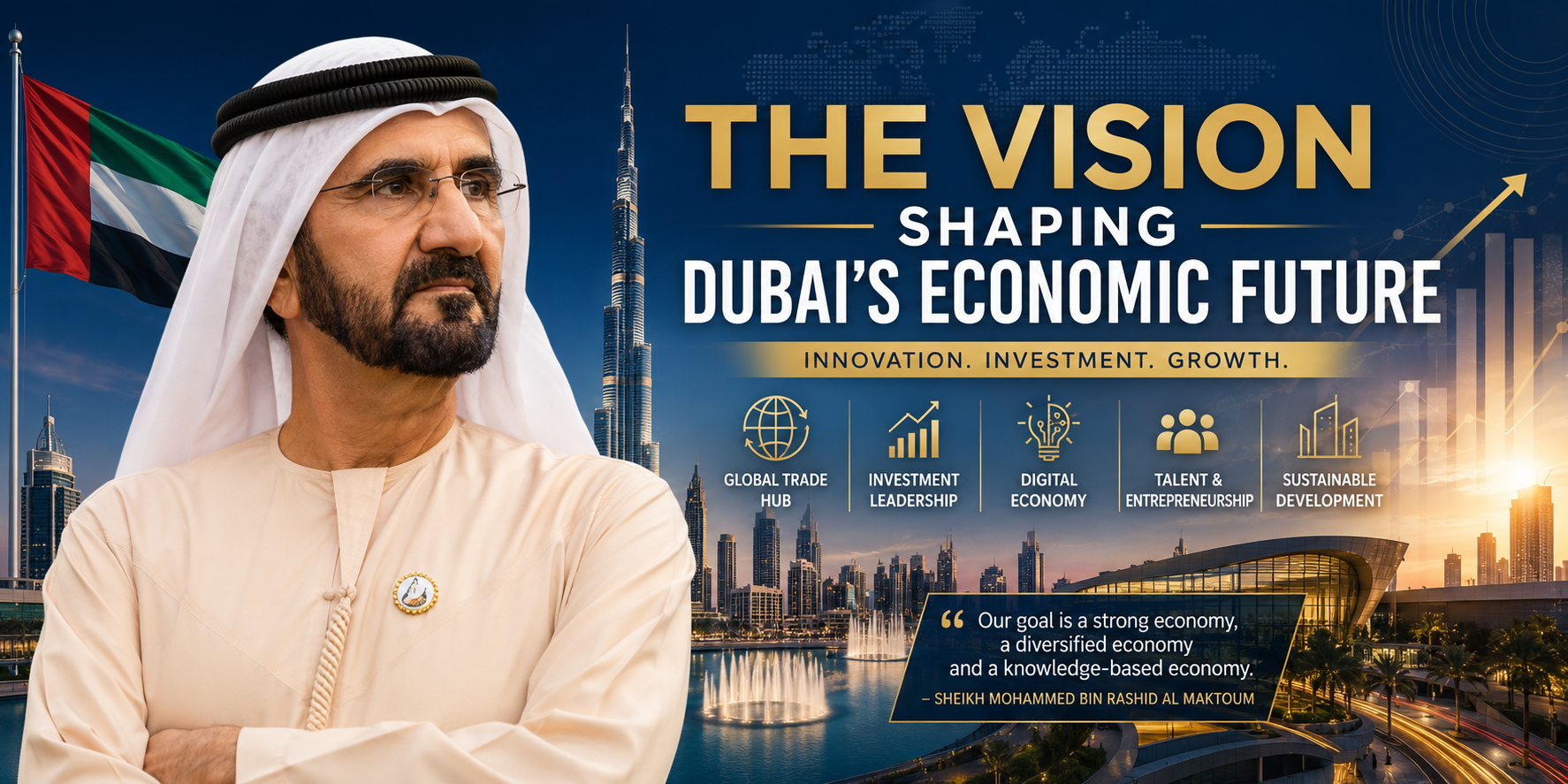
Sheikh Mohammed bin Rashid Al Maktoum has played a prominent role in shaping Dubai’s economic strategy and, through his federal position, the UAE’s wider development agenda. He serves as Vice President and Prime Minister of the UAE and Ruler of Dubai, placing him at the intersection of federal policymaking and the economic transformation of one of the country's most internationally connected emirates.
His economic approach is most visible in Dubai’s expansion as a centre for trade, tourism, aviation, finance, technology and international investment. At the same time, national strategies have increasingly emphasized economic diversification, digital transformation and reducing reliance on hydrocarbons.
The UAE government identifies diversification, foreign direct investment, free zones, government spending, financial reserves and the country's strategic location among the factors supporting its economy.
Understanding Sheikh Mohammed bin Rashid Al Maktoum and the UAE economy, therefore, requires looking beyond individual projects. The bigger story is how long-term economic targets, infrastructure, business-friendly policies, digitalization and global connectivity work together.
Who Is Sheikh Mohammed bin Rashid Al Maktoum?
Sheikh Mohammed bin Rashid Al Maktoum is the Vice President and Prime Minister of the United Arab Emirates and Ruler of Dubai.
His economic influence operates at two interconnected levels. At the federal level, he participates in the leadership and strategic direction of the UAE. In Dubai, he has overseen ambitious economic initiatives designed to increase investment, trade, entrepreneurship, innovation and international competitiveness.
That distinction is important.
It would be inaccurate to attribute the entire performance of the UAE economy to one individual. The UAE is a federation of seven emirates, and economic development involves federal institutions, individual emirates, businesses, investors and many government entities.
However, Sheikh Mohammed has been a major figure in Dubai's transformation and in national initiatives aimed at positioning the UAE for a post-oil, knowledge-based economy.
How Has Sheikh Mohammed Influenced the UAE Economy?
His influence can be seen most clearly through several recurring economic priorities:
-
Diversifying economic activity beyond oil
-
Expanding international trade and investment
-
Building infrastructure that connects the UAE globally
-
Developing digital government and technology
-
Supporting entrepreneurship and private-sector activity
-
Strengthening tourism and international business
-
Setting measurable long-term economic targets
Rather than treating these as isolated initiatives, Dubai has increasingly organized them around broader strategic agendas.
The most prominent current example is the Dubai Economic Agenda D33.
Dubai Economic Agenda D33 and Sheikh Mohammed's Economic Vision
Sheikh Mohammed launched the Dubai Economic Agenda D33 in January 2023.
D33 sets out an ambitious economic roadmap for the decade leading to 2033. According to the Government of Dubai Media Office, its goal is to double the size of Dubai's economy over the decade and consolidate Dubai's position among the world's top three global cities.
The agenda contains 100 transformative projects and sets cumulative economic targets of AED 32 trillion over ten years.
Among its headline ambitions are increasing foreign trade in goods and services from AED 14.2 trillion over the previous decade to AED 25.6 trillion over the following decade.
D33 also aims to increase average annual foreign direct investment from AED 32 billion during the previous decade to around AED 60 billion, targeting AED 650 billion in FDI over ten years.
These figures matter because they reveal the underlying direction of the strategy.
The goal is not simply to increase GDP. It is to make Dubai more deeply connected to global capital, trade, technology and talent.
Economic Diversification Beyond Oil
One of the defining characteristics of the modern UAE economy is its diversification.
Historically, oil transformed the economic structure of the Emirates. However, the country has spent decades expanding non-oil activities.
The UAE government's economic overview identifies economic diversification as one of the factors supporting the country's economic strength.
This diversification includes sectors such as:
-
Tourism and hospitality
-
Aviation and logistics
-
Financial services
-
Real estate
-
Technology
-
Digital services
-
Manufacturing
-
International trade
-
Professional services
-
Creative industries
For Dubai in particular, diversification is fundamental because its economic model is strongly connected with trade, tourism, services, aviation, finance and real estate.
This provides important context for Sheikh Mohammed's economic policies.
Instead of focusing on one dominant sector, Dubai's strategy seeks to create an ecosystem in which multiple industries reinforce each other.
Trade as a Foundation of Dubai's Economic Model
Trade has long been central to Dubai's economic identity.
Its geographic position between Asia, Europe and Africa gives it access to major global markets. Infrastructure development has helped turn that geographic advantage into an economic one.
D33 intends to push this further.
One of the agenda's objectives is to add 400 cities as key trading partners while substantially increasing the value of Dubai's foreign trade over the decade.
This illustrates a broader feature of Sheikh Mohammed's economic strategy: connectivity.
Ports, airports, logistics infrastructure, digital systems and business regulation all influence how efficiently companies can connect with international markets.
For a trading hub, infrastructure is therefore not simply a public service. It is an economic asset.
Attracting Foreign Investment
Foreign direct investment is another central part of the strategy.
International investors evaluate many factors before deploying capital, including regulation, infrastructure, political and economic stability, access to markets, taxation, workforce availability and ease of doing business.
Dubai has worked to create an environment that can compete for this capital globally.
D33's goal of substantially increasing average annual FDI demonstrates how important foreign investment remains to the emirate's long-term economic plans.
Investment can contribute more than money.
International businesses can bring expertise, technology, employment, supplier networks and access to overseas markets.
That is particularly valuable when an economy is seeking to develop higher-value sectors rather than relying primarily on traditional industries.
The Digital Economy and Government Transformation
Another important part of Sheikh Mohammed's legacy is the emphasis on digital government.
The UAE government's official portal notes that Sheikh Mohammed launched the Mobile Government initiative to make government services accessible around the clock.
Digitalization can have direct economic consequences.
When businesses can complete licensing, documentation, payments and government procedures digitally, administrative friction can decline.
Dubai's current strategy extends this concept beyond government services into the wider digital economy.
D33 aims to generate an average of AED 100 billion annually in new economic value from digital transformation. The agenda identifies innovation, knowledge and future technologies as major drivers of the next phase of economic development.
This creates a connection between government efficiency and private-sector innovation.
Digital infrastructure can make government easier to access while also supporting sectors such as fintech, e-commerce, artificial intelligence and technology services.
Tourism and Dubai's Global Economic Position
Tourism is another major component of Dubai's diversified economic model.
Dubai welcomed 19.59 million international overnight visitors in 2025, up 5% from 18.72 million in 2024, according to figures published by Dubai's Department of Economy and Tourism.
Tourism's economic impact extends beyond hotels.
Visitors spend money on restaurants, retail, transport, entertainment, events and other services. The sector also supports employment and creates demand for investment in hospitality and infrastructure.
Dubai's ability to attract international visitors therefore contributes to the wider economic ecosystem.
Its global events, aviation connectivity, hospitality infrastructure and international marketing have helped tourism become part of a broader strategy to make the city a destination not only for holidays but also for business and investment.
Infrastructure as an Economic Growth Tool
Dubai's infrastructure strategy is closely tied to economic development.
Airports, ports, roads, public transport, telecommunications and logistics facilities help determine how efficiently businesses and people can move.
This matters particularly for a city whose economic model depends heavily on international connectivity.
Infrastructure investment can improve productivity while making a location more attractive to companies and investors.
It also creates a foundation for other sectors.
Tourism depends on transport connectivity. International trade depends on logistics. Financial services increasingly rely on digital infrastructure. Real estate demand can grow when businesses and workers enter the market.
This interconnected approach helps explain why infrastructure has remained such a visible component of Dubai's development.
Entrepreneurship and the Private Sector
Government investment alone cannot build a diversified economy.
Private companies, entrepreneurs and international investors are essential to creating jobs, innovation and new economic activity.
D33 therefore includes a target to increase private-sector investment from AED 790 billion during the preceding decade to AED 1 trillion by 2033.
This illustrates the relationship between government strategy and private capital.
The government can create infrastructure, regulations and economic initiatives, but sustainable growth ultimately requires businesses to invest and compete.
For entrepreneurs, this also means that Dubai's economic ambitions increasingly extend into emerging sectors, technology, digital services and innovative business models.
From Dubai's Strategy to the Wider UAE Economy
It is important not to treat Dubai and the UAE as interchangeable.
Dubai is one of seven emirates, while the UAE economy includes significant economic activity in Abu Dhabi, Sharjah and the other emirates.
However, Dubai's economic performance contributes significantly to the federation's broader diversification story.
At the national level, the UAE's "We the UAE 2031" vision aims to increase national GDP from AED 1.49 trillion to AED 3 trillion.
That national objective complements the emphasis on investment, technology, exports and non-oil industries.
The UAE government's published economic data show why diversification matters. In 2023, national GDP reached AED 1.88 trillion at current prices, while non-oil GDP reached AED 1.43 trillion and recorded 9.9% growth at current prices compared with 2022.
Those figures demonstrate that the modern UAE economy cannot be understood simply as an oil economy.
Government Spending and Long-Term Planning
Dubai's economic strategy is also reflected in public finance.
Sheikh Mohammed approved Dubai's 2025 to 2027 general budget cycle with projected total expenditure of AED 272 billion and revenues of AED 302 billion.
For 2025 alone, estimated expenditures were AED 86.26 billion, while projected revenues were AED 97.66 billion.
The budget was designed to support sustainable economic growth while funding areas including infrastructure, education, health and social development.
This highlights an important point about economic competitiveness.
An attractive business environment is not built only through corporate policies. Quality of life, education, infrastructure and public services can influence whether professionals, entrepreneurs and companies choose to establish a long-term presence in a city.
What Makes Sheikh Mohammed's Economic Approach Distinctive?
Rather than reducing his economic approach to a single policy, several recurring characteristics can be identified from official strategies.
| Strategic Area | Economic Objective |
|---|---|
| Diversification | Reduce dependence on individual sectors |
| Global trade | Expand Dubai's international commercial connections |
| Foreign investment | Attract international capital and businesses |
| Digital economy | Generate new value through technology |
| Infrastructure | Improve global and domestic connectivity |
| Tourism | Strengthen visitor-driven economic activity |
| Entrepreneurship | Encourage private-sector growth |
| Long-term planning | Set measurable economic goals |
What connects these areas is a focus on competitiveness.
Dubai does not operate in isolation. It competes with cities around the world for companies, investors, visitors, entrepreneurs and skilled professionals.
Economic strategy therefore increasingly involves making the city attractive to each of those groups simultaneously.
Challenges Facing the UAE's Economic Ambitions
Strong growth targets do not remove economic risks.
The UAE remains exposed to changes in the global economy, energy markets, international trade, interest rates and geopolitical conditions.
Rapid growth also creates domestic challenges.
Infrastructure must keep pace with population and business expansion. Housing affordability, transportation, sustainability and workforce development can become increasingly important as cities grow.
Diversification itself is an ongoing process rather than a completed achievement.
New industries must become productive and internationally competitive if they are to create sustainable economic value.
For that reason, D33 and similar strategies should ultimately be evaluated not only by their headline targets but by measurable results over time.
What Is the Future of the UAE Economy?
The UAE's future economic direction increasingly points toward a combination of trade, investment, technology, tourism, advanced industries and knowledge-based activity.
The federal government describes the country as continuing its transition toward a knowledge-based economy through innovation and stronger regulatory frameworks for key sectors.
Nationally, "We the UAE 2031" provides a framework for expanding GDP and strengthening the country's economic and investment position.
Dubai's D33 agenda operates alongside those national ambitions.
Together, they indicate that future economic growth is expected to depend increasingly on productivity, technology, human capital, global connectivity and private investment rather than simply natural-resource revenues.
Frequently Asked Questions
How has Sheikh Mohammed bin Rashid Al Maktoum influenced the UAE economy?
His influence is particularly visible through Dubai's economic development, including policies and initiatives focused on diversification, trade, tourism, investment, infrastructure, digital transformation and entrepreneurship. As UAE Vice President and Prime Minister, he also participates in national strategic development.
What is the Dubai Economic Agenda D33?
D33 is Dubai's economic agenda for the decade leading to 2033. Launched by Sheikh Mohammed in 2023, it aims to double Dubai's economy and strengthen its position among leading global cities.
Is the UAE economy still dependent on oil?
Oil remains economically important, particularly to Abu Dhabi, but the UAE has developed substantial non-oil sectors. Government figures show non-oil GDP reached AED 1.43 trillion at current prices in 2023.
What industries drive Dubai's economy?
Important sectors include trade, tourism, aviation, logistics, financial services, real estate, technology, professional services and the digital economy.
How important is foreign investment to Dubai?
Foreign investment is a major component of D33. The agenda targets an average of AED 60 billion in annual FDI and AED 650 billion cumulatively over ten years.
What role does technology play in Dubai's economic strategy?
Technology is increasingly central. D33 seeks to generate an average of AED 100 billion annually in new economic value from digital transformation.
What is the UAE's long-term GDP target?
The national "We the UAE 2031" vision aims to increase GDP from AED 1.49 trillion to AED 3 trillion.
Conclusion
The relationship between Sheikh Mohammed bin Rashid Al Maktoum and the UAE economy is best understood through the long-term economic transformation of Dubai and his broader role in the UAE's federal leadership.
His economic agenda has consistently emphasized diversification, global trade, infrastructure, tourism, technology, private enterprise and international investment.
D33 now brings many of those priorities together under measurable targets for the next stage of Dubai's development.
Yet the broader UAE economic story extends beyond any single leader or emirate. It is the product of federal and local institutions, businesses, investors and long-term national strategies.
What Sheikh Mohammed's approach demonstrates particularly clearly is the importance placed on planning ahead. Instead of relying solely on existing economic strengths, Dubai continues to invest in the industries, infrastructure and international connections it expects to matter in the future.
