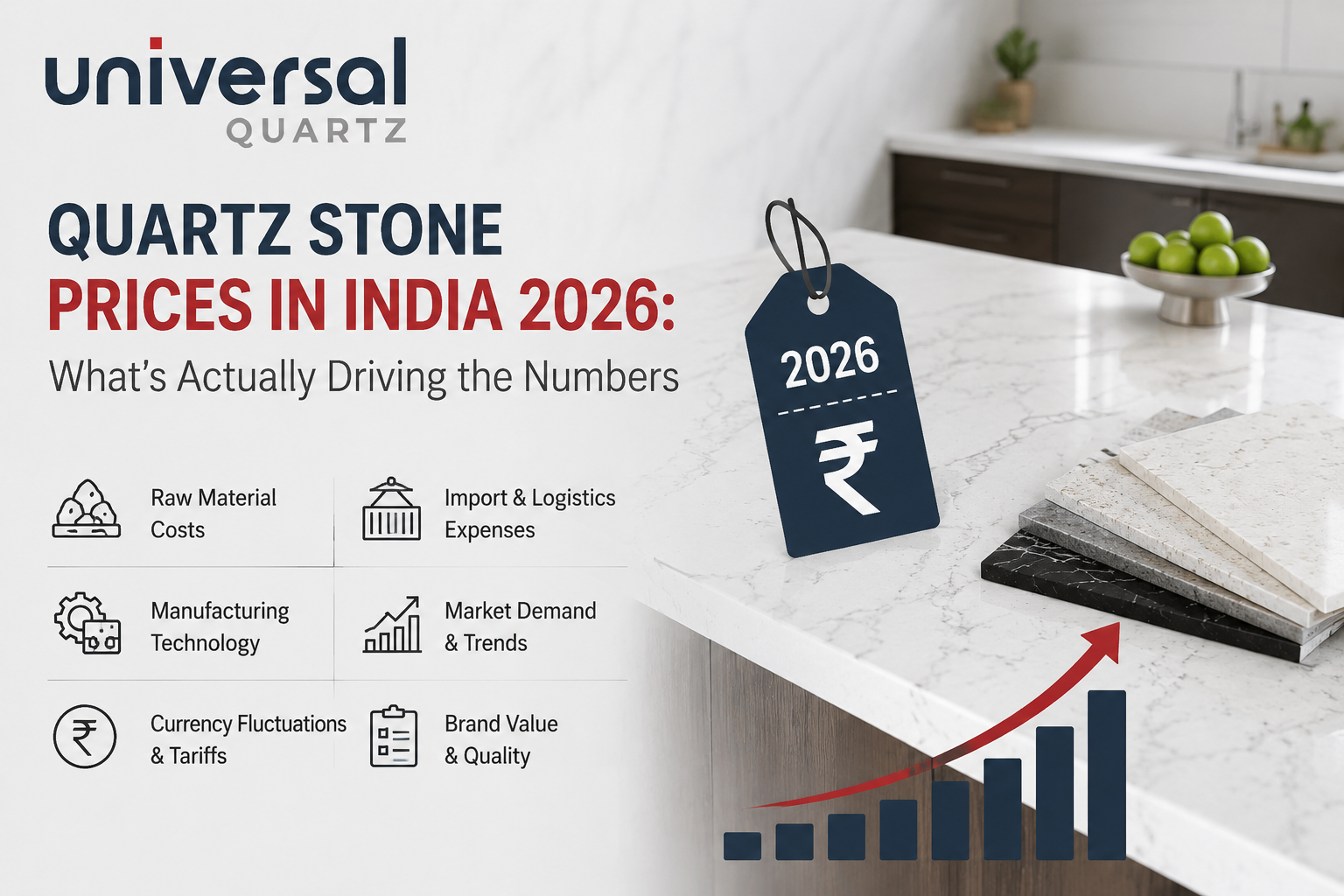
Quartz Stone Prices in India 2026: What's Actually Driving the Numbers
0
55

If you've priced quartz countertops recently, you've probably noticed something confusing: two slabs that look almost identical can be quoted ₹200 or ₹300 apart per square foot. It's not random, and it's not always a markup — there are specific, measurable factors behind every quote, and understanding them is the difference between negotiating from a position of knowledge and just picking whatever number sounds reasonable.

Here's what's really moving the needle on quartz pricing in India this year.

Design complexity is the single biggest swing factor

A plain white or grey quartz slab and a Calacatta-pattern slab can come from the same production line and still land in completely different price brackets. That's because replicating natural marble veining — especially the dramatic, multi-directional veining of Calacatta or Statuario patterns — requires more precise tooling, more production time, and tighter quality control to keep the pattern consistent across a slab. Sparkle and mono-colour designs, by contrast, are mechanically simpler to produce and sit at the entry end of the price range. A detailed 2026 quartz stone price guide breaks these design categories down by exact rupee range, which is worth a look if you want to see where your preferred pattern actually falls before you start collecting quotes. If budget is the priority, this is the first lever to pull — not brand, not thickness, but design.

Thickness changes both cost and application

12mm and 15mm slabs are lighter on material and cheaper, but they're only suited to low-traffic vertical surfaces like wall cladding — not countertops. 18mm is the common residential compromise. 20mm has become the industry-recommended standard for kitchen countertops because it balances heat resistance, structural rigidity, and visual depth, and most manufacturers price it as their "default" premium tier. Going up to 30mm is really a luxury and export-grade decision, not a practical one for most homes.

Certifications aren't just a badge — they cost money to earn

This part surprises a lot of first-time buyers. ISO 9001:2015, GREENGUARD Gold, NSF, and CE Mark certifications each require third-party testing and ongoing compliance audits, and manufacturers who hold multiple certifications are recovering that cost in their pricing. For a residential kitchen, ISO alone is usually sufficient. But for healthcare, hospitality, or any green-rated building project, GREENGUARD Gold (indoor air quality) and LEED/IGBC compliance stop being optional — they're often mandated in the project spec. A recent industry pricing breakdown from Universal Quartz, one of the few Indian manufacturers holding the full certification stack, lays out exactly how design type, thickness, and certification level stack together into a final price — useful reading if you want to see the actual rupee ranges rather than rules of thumb.

Where you buy matters more than most people realize

Factory-direct pricing and authorised-dealer pricing are consistently lower than retail showroom pricing, sometimes by a meaningful margin, because showroom markups exist to cover retail overhead that a factory relationship skips entirely. If you're working with an architect or contractor who can source directly from a manufacturer's branch network, that's often the single easiest way to reduce cost without touching design or thickness at all. Manufacturers like Universal Quartz, which sells factory-direct through branch offices across multiple states, are a good example of how this cuts out the intermediary markup entirely.

Location adds a smaller, but real, premium

Metro pricing in Mumbai, Delhi, and Bengaluru tends to run 5–10% higher than in manufacturing hubs like Jaipur, purely on logistics. If a manufacturer has branch offices closer to your project site, that freight premium shrinks or disappears. This is a small factor compared to design and certification, but it adds up on large-format commercial projects.

What this means for your buying decision

None of these factors work in isolation — the real quote you get is design complexity, thickness, certification level, buying channel, and location, all layered together. The mistake most buyers make is comparing quotes on price alone without checking whether they're actually comparing the same thickness, the same certification tier, and the same buying channel. Two "20mm quartz" quotes that are ₹150 apart usually aren't describing the same product.

Before signing off on a quartz purchase in 2026, it's worth asking every supplier the same four questions: What thickness and design category is this quote for? Which certifications does it carry? Is this factory-direct or through a dealer? And is the price inclusive of fabrication and edge profiling, or just the raw slab? Get those four answers from two or three suppliers, and the "confusing" price spread usually turns out to be entirely explainable. Manufacturers with transparent, published pricing frameworks — Universal Quartz's 2026 guide being one example — make that comparison considerably easier, since the variables are already broken out for you instead of buried in a single lump-sum quote.

For buyers who want to see how these factors actually play out across a full product range, manufacturers like Universal Quartz publish their certification stack and product series openly, which makes it easier to line up a quote against a known baseline rather than negotiating in the dark.

Frequently Asked Questions

Q: Why do two quartz slabs with the same thickness have such different prices? A: Thickness is only one variable. Design complexity (plain vs. Calacatta-style veining), certification level, and whether you're buying factory-direct or through a dealer all move the price independently of thickness.

Q: Is certified quartz always worth the extra cost? A: For residential kitchens, a basic ISO certification is usually enough. For hospitality, healthcare, or green-rated buildings, GREENGUARD Gold and LEED/IGBC compliance are often required by the project spec, not optional extras — so the premium is justified by the use case rather than by marketing.

Q: What's the easiest way to bring a quartz quote down without compromising quality? A: Buying factory-direct instead of through a retail showroom is usually the single biggest lever, since it removes retail markup without changing the design, thickness, or certification of the slab itself.

Q: Does location really affect quartz stone pricing in India? A: Yes, but modestly. Metro cities typically run 5–10% higher than manufacturing hubs due to freight and logistics, though this gap narrows if the manufacturer has a branch office near the project site.

Q: Where can I check current quartz stone price ranges by design and thickness? A: Manufacturers like Universal Quartz maintain detailed, regularly updated pricing breakdowns by design type, thickness, and city — a more reliable reference point than a single showroom quote.

Search
Categories
Read More
Shopping
How Long Does Vuori Shipping Take? A Complete Delivery Guide
When shopping online, one of the most common questions customers ask is, “How long...
By Vuori Clothing US 2026-07-26 15:34:33 0 72
Home
Degree Through ACCA in Sri Lanka | Wisdom Business Academy
Degree Through ACCA in Sri Lanka A Degree Through ACCA is one of the smartest pathways for...
By Williams Thomas 2026-07-24 10:13:51 0 49
Networking
Learning Management System UAE for Smart Workforce Development
Learning Management System UAE Enhancing Modern Business Growth Businesses now require advanced...
By Ginkgo Retail 2026-07-22 13:48:05 0 117
Shopping
How Can Custom Mylar Bags Improve Product Protection and Brand Value?
  Packaging plays an important role in protecting products, maintaining freshness, and...
By Fast Custom Boxes 2026-07-23 16:58:58 0 110
Shopping
Banarasi Saree Shop in Varanasi | Authentic Handwoven Silk Sarees
Varanasi, one of the world's oldest living cities, is celebrated not only for its spiritual...
By Cross Woven 2026-08-06 17:53:42 0 106