


The 2026 AI EdTech Market Map: Who Builds What, and Where the Real Gaps Are
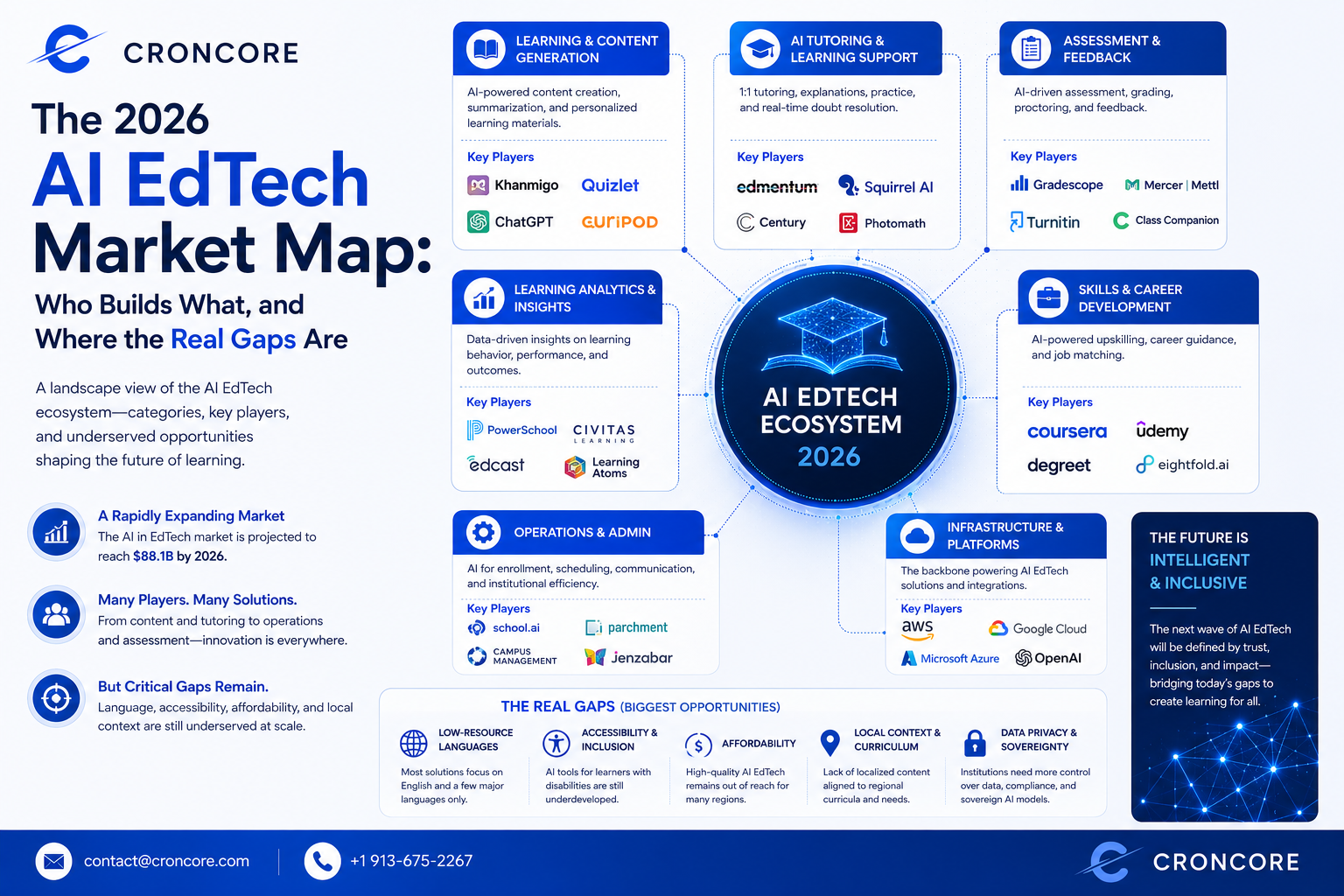
Every few months someone publishes an AI edtech market map, and it is almost always a logo grid. Two hundred AI edtech companies sorted into boxes labeled "tutoring," "assessment," and "admin," with no indication of which ones are infrastructure, which ones are applications, and which ones are a thin interface over somebody else's model. That format tells you who exists. It does not tell you what is actually built, which is the only question that matters if you are deciding whether to buy a tool, partner with a vendor, or commission custom EdTech AI development for your own platform. So this map is organized by layer instead of by category, because the layer a company occupies tells you far more about its defensibility than its product label does.
Here is the stack, from the bottom up.
Layer one: infrastructure, where AWS EdTech sits
Almost every AI edtech tool you can name runs on somebody else's compute, and in education that somebody is disproportionately Amazon. AWS EdTech is not a product so much as a gravitational field. AWS reports serving over 17,000 education customers spanning schools, universities, and edtech vendors, and it has built dedicated on-ramps for the sector: AWS Activate credits for startups, the AWS Education Accelerator, and a specialist team organized by segment rather than by region.
The commitments are substantial enough to shape the market. The AWS Education Equity Initiative pledged up to $100 million in cloud and AI technology through 2029, and by early 2026 more than 300 organizations across 40 countries had received credits, with roughly three quarters of them folding AI and machine learning into their platforms. AWS also co-runs the GSV Cup with GSV Ventures and Pearson, whose 2026 cohort of 50 early-stage companies had collectively raised over $177 million.
What this means practically: infrastructure is not a differentiator. If your pitch to a school district is that you run on AWS, you have said nothing, because so does everyone you are competing against. The interesting layers are higher up.
Layer two: models, and the difference between wrapping and building
This is where the map gets genuinely useful, because it separates the two groups of AI edtech companies that marketing language deliberately blurs.
The first group calls a foundation model API, wraps it in a chat interface, and adds a school logo. Cheap to build, impossible to defend, and increasingly obvious to buyers who have seen a dozen demos. The second group builds something structural on top: a knowledge graph, a mastery model, a retrieval layer grounded in actual curriculum documents, an evaluation harness tuned against teacher judgment.
Squirrel AI is the clearest example of the second group, which is why it appears on every serious ai edtech market map. The Shanghai company, founded in 2014, decomposes subjects into very fine-grained "knowledge points" and routes students through them using what it calls a Large Adaptive Model, trained on behavioral data from tens of millions of learners. TIME named it one of the most influential companies of 2026, citing reach of roughly 52 million students across 60,000 schools and learning centers, mostly across Asia. It is now attempting a US entry through a separate American arm, which will test whether an engine tuned to Chinese curricula can adapt to American standards.
Whatever you think of the company, the architecture is the lesson. The knowledge graph and the behavioral dataset are the moat. The language model is a component, not the product.
Layer three: applications, or what edtech ai tools actually do
Above the models sit the tools schools actually purchase, and they cluster into five recognizable jobs.
Adaptive tutoring is the largest and most contested category, covering everything from genuine step-by-step tutors to answer machines with a friendly tone. Automated grading is the category with the clearest economic case, because a teacher facing 150 essays does not need AI opinions, they need consistent rubric-anchored first-pass scoring with a rationale attached to every mark. Content generation covers practice problems, lesson scaffolds, and differentiated materials pinned to standards. Learning analytics covers mastery tracking and intervention signals, delivered to instructors without exposing individual student data outside the school. And speech and oral assessment covers reading fluency, pronunciation practice, and oral exams, a category that off-the-shelf speech APIs handle badly because they were never tuned for young or accented voices.
The pattern worth noticing across all five: the demo is easy and the deployment is hard. Curriculum alignment, teacher controls, LMS integration, and audit trails are what separate the tools that survive a pilot from the ones that quietly churn in March.
Layer four: governance, and why an AI observatory belongs on the map
Most market maps stop at the application layer, which is a mistake in education, because this sector is governed in a way that consumer AI is not. Education AI is an Annex III high-risk category under the EU AI Act, and it processes children's data, which triggers heightened protection under FERPA, COPPA, and GDPR simultaneously.
The governance layer is now institutionalizing. In April 2026, UNESCO launched the Observatory on Artificial Intelligence in Education for Latin America and the Caribbean at ECLAC headquarters in Santiago, convening 33 education ministries alongside universities, development banks, and research centres, with an advisory council that includes the OECD, the Organization of Ibero-American States, Harvard experts, and the UN scientific panel on AI. An AI observatory of this kind is not a passive research shop. It produces comparative evidence, shapes teacher training, and feeds directly into procurement standards. UNESCO framed the underlying principle bluntly: AI should not govern education, education should govern AI.
For vendors, this layer is a leading indicator. Observatory findings become ministry guidance, and ministry guidance becomes the questionnaire your sales team has to answer.
Where the gaps actually are
Read the map by layer and the white space becomes visible.
The crowded zones are general-purpose tutoring for mainstream subjects in English, and lightweight content generators for teachers. Both are saturated, both compete on price, and both are exposed the moment a foundation model ships the same capability for free.
The thin zones are more interesting. Multilingual and low-resource-language instruction remains badly underserved, particularly where instruction crosses dialects and scripts, which is precisely where national platforms and education ministries are spending. Oral and speech assessment is thin for the same technical reason it is valuable. Compliance-native architecture is thin because it is unglamorous and cannot be retrofitted. And vertical depth, meaning tools built for one subject or one national curriculum rather than for everyone, keeps outperforming horizontal breadth in actual district renewals.
How to read any market map, including this one
The useful question is never "which box is this company in." It is "what would it cost a competitor to rebuild this." Infrastructure is rented. Model access is rented. Curriculum alignment, teacher trust, behavioral data, and compliance architecture are built, slowly, and they are the reason two products that demo identically perform completely differently in their second year.
That is also the honest answer to build versus buy. Buy the commodity layers, because rebuilding infrastructure is a waste of capital. Build the layers that touch your curriculum, your rubrics, your students' data, and your teachers' judgment, because those are the only parts a buyer will eventually be choosing you for.
