


Launching a Crypto Token vs Building a Token-Based Business: Key Differences
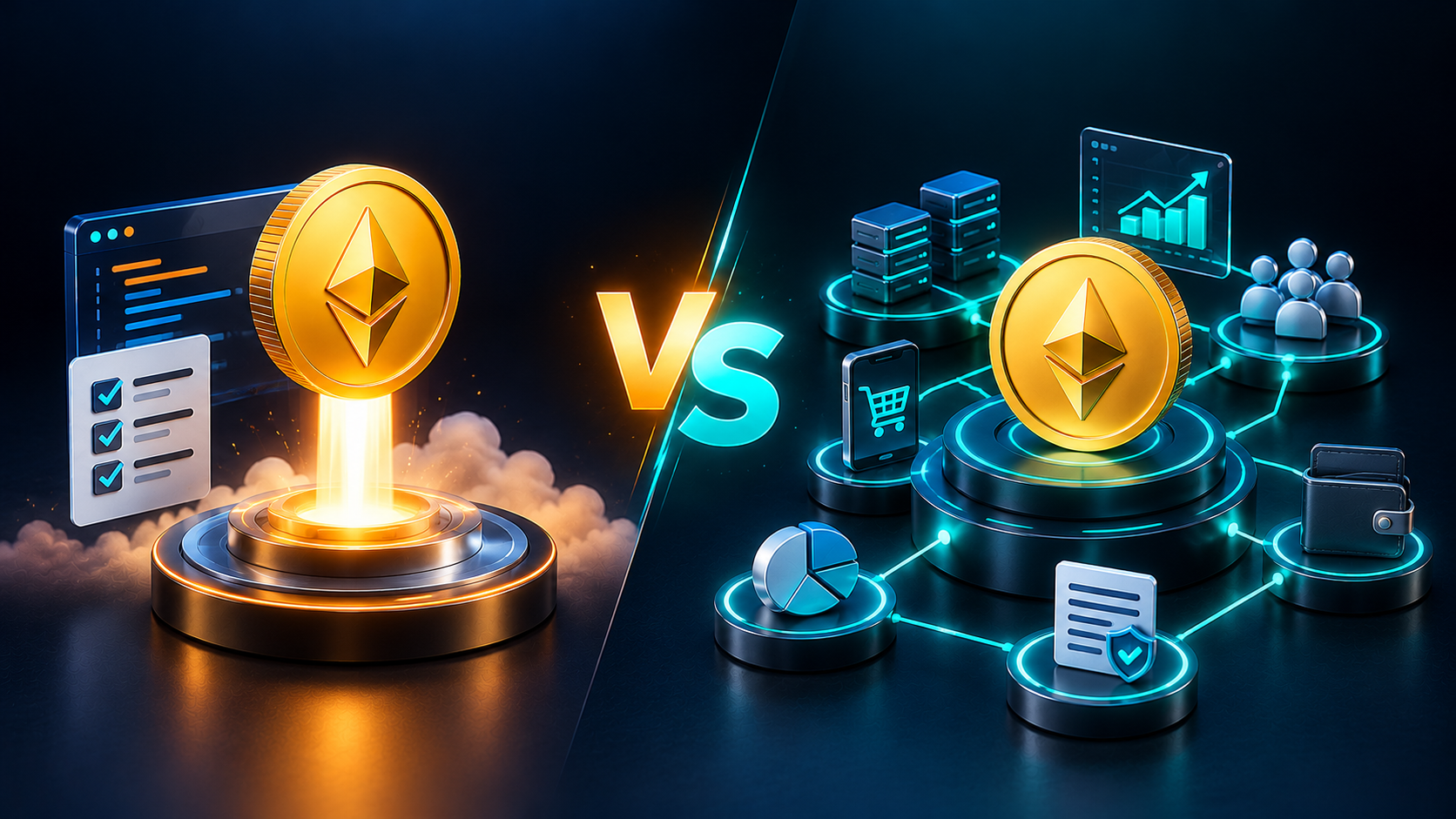
A crypto token is a digital asset recorded on a blockchain. Depending on its design, it can provide access to services, support governance, reward participation, represent eligible assets, or facilitate transactions within an application. Standards such as Ethereum's ERC-20 define common functions that help fungible tokens interact with wallets, exchanges, and decentralized applications. This interoperability makes token creation more accessible, but it does not establish commercial demand. Ethereum's ERC-20 documentation explains the technical foundation.
A token-based business requires a wider operating structure. Founders must identify the customers they serve, the problem their product solves, the role the token plays, and the activities that generate recurring value. They also need to consider customer acquisition, product development, support, compliance, treasury management, and long-term maintenance.
Consider a startup that creates a token for a decentralized storage platform. Deploying the token and making it transferable may be technically straightforward. Building a functioning business requires reliable storage, a usable interface, a payment model, demand from customers, and incentives for storage providers. If users can access the same service more easily through a conventional payment method, the business must explain why its token adds practical value.
The distinction is straightforward: token creation delivers an on-chain asset, while business development creates the conditions for people to use that asset repeatedly.
Token Utility Must Connect to a Real Customer Need
Token utility should emerge from the product's operating model rather than from a desire to launch a cryptocurrency. Founders need to determine what users can do with the token and why that function is useful enough to encourage adoption.
A utility token might pay for platform access, cover transaction fees, unlock specific features, or reward measurable contributions. A governance token might allow eligible holders to vote on defined protocol decisions. A token representing an interest in a real-world asset requires an appropriate legal and operational framework that connects the digital record to the underlying rights.
Each model creates different responsibilities. A payment token needs a clear transaction flow and a reason for customers to hold or acquire it. A governance token needs meaningful decisions, transparent voting procedures, and safeguards against concentrated influence. A token used for platform rewards needs an economic model that prevents incentives from becoming the only reason people participate.
Founders should also distinguish between stated utility and actual usage. A white paper may describe multiple token functions, but those functions have limited commercial value if customers rarely use them. Tracking active users, repeat transactions, retention, and the share of product activity involving the token can reveal whether its role supports genuine demand.
Before development begins, a project should be able to explain the customer problem, the token's specific function, and why a blockchain-based design is appropriate. If the token does not improve the product's operation or user experience, the business may need to reconsider whether it needs a token at all.
Tokenomics Must Support the Business Model
Tokenomics describes how a token's supply, distribution, incentives, and economic rules operate. These decisions can affect participation, treasury planning, governance, and market expectations. They should be designed around the business model instead of being treated as a separate exercise.
Founders need to decide the initial supply, distribution among stakeholders, vesting schedules, any minting or burning mechanisms, and the conditions under which tokens enter circulation. They must also examine how rewards are funded and whether the project can sustain them without depending indefinitely on new participants.
For example, a platform that distributes tokens to attract early users may experience rapid sign-ups during a reward campaign. Yet if those users leave once rewards decline, the campaign may have generated temporary activity rather than durable demand. A stronger model connects incentives to useful contributions, such as completing transactions, providing needed liquidity, or helping the platform deliver its service.
Token distribution also affects confidence. Unclear allocations, concentrated ownership, and poorly communicated unlock schedules can create concerns among users and investors. Transparent disclosures and predictable release policies help stakeholders understand how the supply may change over time.
Founders should evaluate token economics alongside operating costs, customer willingness to pay, and the treasury's capacity to fund development. A token's market price is not a substitute for business revenue, and a rising valuation does not necessarily indicate that a product has found sustainable demand.
Technology Must Support a Working Product
Launching a token generally involves selecting a blockchain, choosing an appropriate token standard, developing the smart contract, testing its behavior, and deploying it. Building a token-based business involves these steps plus the technology required to deliver the product itself.
Depending on the use case, that wider system may include a web or mobile application, user authentication, wallet integration, payment processing, analytics, governance tools, liquidity integrations, and connections to external services. The token contract must work reliably with these components.
Security deserves attention from the earliest design stage. Developers need to review access permissions, transfer logic, minting authority, administrative functions, and any upgrade mechanism. Testing should cover normal transactions as well as unexpected inputs and failure conditions. Independent security reviews may be appropriate when the token controls substantial value or interacts with other financial contracts.
Compatibility matters too. Ethereum's token standards help applications recognize and interact with assets that follow established interfaces, but compliance with a standard does not automatically make a contract secure or guarantee integration with every platform. Founders must assess the wallets, exchanges, protocols, and networks relevant to their intended users.
The right technical architecture depends on the product's actual requirements. Selecting a blockchain based only on popularity or low transaction fees may create problems later if its ecosystem, tooling, security assumptions, or user base does not fit the business.
What Established Projects Teach About Token-Based Businesses
Uniswap offers a useful example of the distinction between a token and the product ecosystem surrounding it. The decentralized exchange protocol was already operating before UNI launched in September 2020. In its launch announcement, Uniswap reported more than $20 billion in trading volume across over 250,000 unique addresses during its first two years. The UNI token was introduced to support community-led growth and governance, rather than serving as a replacement for the underlying exchange product. These figures describe the protocol's historical activity at launch, not its current performance.
The example illustrates an important strategic point: a token can contribute to an existing product's governance and ecosystem, but the token itself does not create the product's usefulness. The underlying protocol, user experience, integrations, and liquidity had already established a reason for people to interact with the platform.
Founders should not assume that every project needs to follow this sequence. Some businesses may reasonably launch a token early because it is integral to their operating model. Others may benefit from validating the product first and introducing a token only after its role becomes clear.
The broader lesson is to build around a real activity that users value. A token can coordinate participation, enable particular functions, or support community governance. It cannot independently provide product-market fit.
Compliance and Transparency Are Part of Business Development
Token-based businesses must assess legal requirements according to their token's design, distribution, intended users, and jurisdictions. A token's label does not determine its regulatory treatment. Features involving investment rights, profit expectations, asset ownership, payments, or public fundraising may trigger different obligations.
For example, the US Securities and Exchange Commission's Division of Corporation Finance published a statement on April 10, 2025, discussing disclosure considerations for securities offerings involving crypto assets. The statement highlights the relevance of information about token supply, minting, vesting, holder rights, risks, and related controls in applicable offerings. It is not a blanket determination that all crypto tokens are securities.
For founders, compliance planning should begin before marketing or distribution. Depending on the business, the team may need legal advice on offering structure, transfer restrictions, disclosures, consumer protection, anti-money-laundering obligations, and other applicable rules.
Transparency also supports business credibility. Users should understand what the token does, what rights it provides, which parties control important functions, and what risks remain. Clear documentation, accessible contract information, and accurate marketing help align expectations with the product's actual capabilities.
Measure Business Progress Beyond Token Price
A token launch can produce visible short-term indicators, including trading volume, wallet creation, social engagement, and exchange activity. These metrics can help teams assess initial interest, but they do not necessarily demonstrate that a business is sustainable.
A token-based business should also measure product usage and commercial performance. Relevant indicators may include repeat users, customer retention, completed transactions, paid conversions, revenue from core services, protocol fees where applicable, and the cost of acquiring and supporting customers.
The most useful metrics depend on the business model. A decentralized storage platform might track paid storage demand and provider reliability. A gaming ecosystem might examine active players, repeat participation, and spending on useful in-game features. A governance protocol might monitor participation quality and whether decisions lead to effective improvements.
Founders should compare these indicators over time instead of relying on a single successful launch event. If token trading remains active but product usage declines, the team needs to investigate the gap. If users continue returning and paying for the product even during periods of weaker market interest, the business may have a more durable foundation.
Build the Business Before Relying on the Token
Launching a crypto token and building a token-based business are connected but distinct undertakings. Token deployment establishes an asset and its programmed rules. A business requires a useful product, clear token utility, sustainable economics, secure technology, user trust, and a plan for ongoing operations.
For founders, the practical starting point is to define the business problem and validate demand before finalizing token mechanics. The token's role should follow from that strategy. Supply, distribution, smart contract design, blockchain selection, and governance should then support the product rather than distract from it.
Blockchain App Factory helps businesses plan and develop crypto tokens, including token functionality, tokenomics, smart contracts, and blockchain deployment. Founders exploring these requirements can learn more about crypto token development services and assess how a token can fit into a broader Web3 business model.
