


How to Dry Wet Leather Motorcycle Racing Gloves Without Shrinking the Fingers
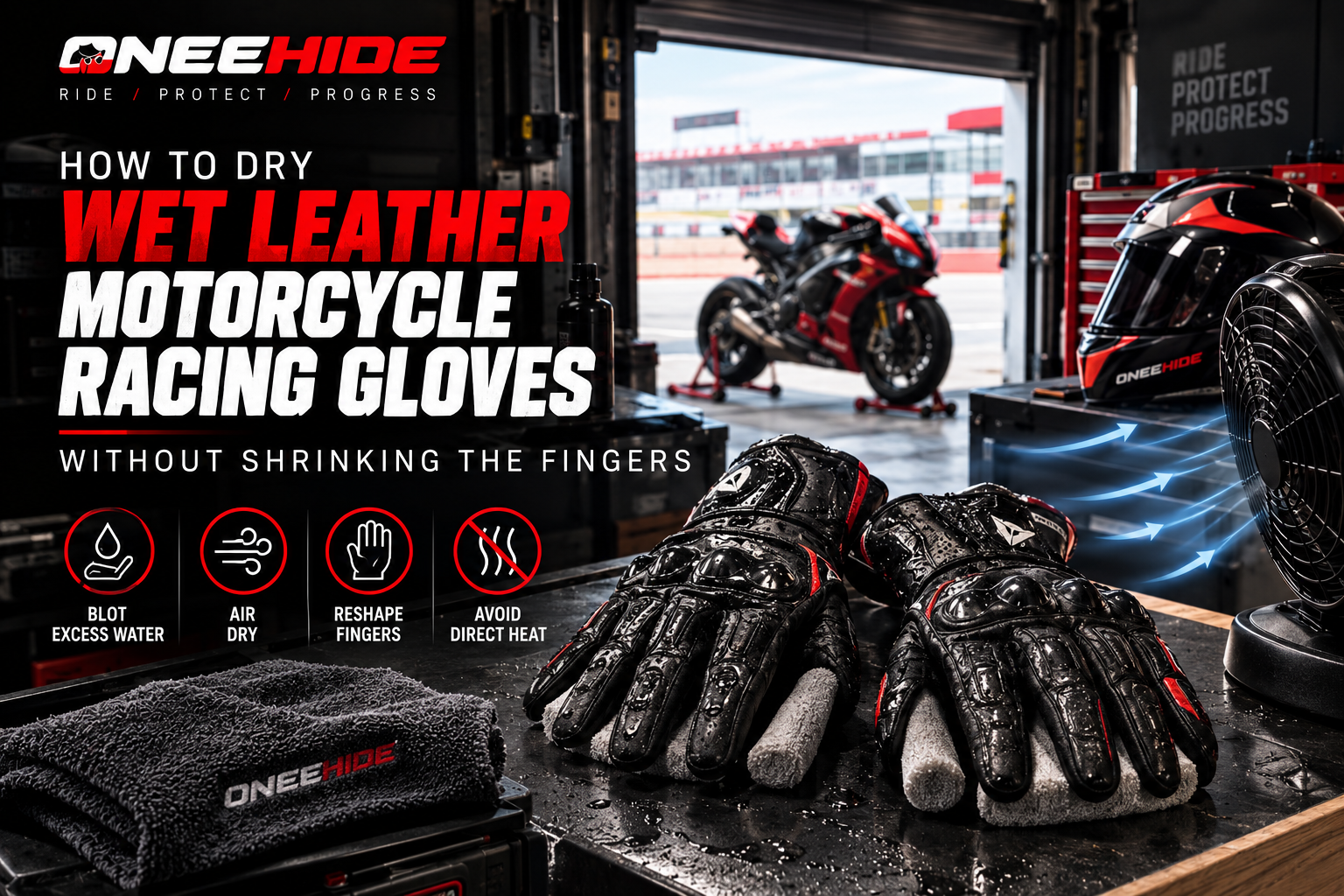
Wet leather motorcycle gloves create a deceptively difficult problem. The instinct is often to dry them as quickly as possible, but leather does not respond well to aggressive heat. A radiator, hair dryer, heater, tumble dryer, or direct sun can remove moisture too quickly and leave the leather stiff, distorted, or more prone to cracking.
The safer approach is slower: remove excess water, open the gloves up, restore their shape, and let them dry naturally with good airflow. Riders who use leather motorcycle gloves for track sessions or spirited road riding should be especially careful because finger fit matters for brake and clutch control, while the glove's seams, armor, and closures also need to retain their intended shape.
The aim is not simply to make a wet glove dry. It is to dry the glove without changing the shape, flexibility, or protective construction that made it fit correctly in the first place.
Why fast drying can damage wet leather gloves
Leather contains a complex structure of fibers and finishes that can be affected by excessive heat and rapid drying. When wet leather is exposed to strong heat, the moisture can leave the material too quickly, potentially causing stiffness, brittleness, shrinkage, or changes in shape.
That is particularly problematic in motorcycle gloves because the fingers are constructed around a relatively precise shape. The palm and fingers also contain seams, reinforcement materials, protective components, and lining material that all need to work together.
Alpinestars' motorcycle glove care guidance recommends allowing wet gloves to air dry naturally and specifically warns against direct heat, machine drying, and other excessive heat sources because they can affect the material, fit, and protective components.
A glove that becomes slightly stiff after drying may still look acceptable. The more important question is whether its shape, flexibility, and protective components still function as intended.
The first step is to remove excess water without wringing
When leather gloves are soaked, do not twist them aggressively.
Wringing puts unnecessary stress on the seams and can distort the finger and palm construction. Instead, gently press the gloves against a clean absorbent towel.
The objective is to remove surface and readily accessible moisture, not to force every drop out of the leather.
A simple sequence is:
-
Remove the gloves as soon as practical.
-
Gently blot the exterior with a clean towel.
-
Open the cuffs completely.
-
Separate the fingers so air can reach the interior.
-
Reshape the fingers and palm with your hands.
-
Move them to a ventilated indoor location.
If the gloves are only damp from rain or sweat, this may be enough to start the drying process. If they are thoroughly saturated, they need more attention before being left to dry.
Never use a radiator, hair dryer, or tumble dryer
Direct heat is the most important thing to avoid.
It may seem logical to place wet gloves beside a heater because faster evaporation feels like a better solution. The problem is that the glove does not simply contain water. It also contains leather, adhesives, stitching, liners, protective components, and other materials that can respond differently to heat.
Büse's leather motorcycle clothing care instructions warn that tumble drying and hot heat sources can damage the leather's fiber structure and make the surface brittle.
Alpinestars likewise advises natural air drying away from direct heat sources and recommends avoiding machine drying.
That makes the common "hair dryer for ten minutes" solution a poor choice for a protective leather glove. Warm air from a distance may appear harmless, but you have little control over how quickly different parts of a small glove heat and dry.
How to keep the fingers from shrinking or deforming
The fingers are where drying problems become especially noticeable.
If wet leather dries while the glove is collapsed or folded, the finger channels can become misshapen. The glove may then feel unusually tight at the fingertips or difficult to close around the hand.
Before leaving the gloves to dry, gently restore their natural shape.
Straighten each finger without stretching it. Separate adjacent fingers. Open the palm. Keep the cuff open so air can circulate into the glove.
For very wet gloves, absorbent paper can be placed loosely inside the fingers and palm. Do not pack the glove tightly. The purpose is to help absorb moisture while allowing the leather to retain its normal three-dimensional shape.
Alpinestars' current motorcycle glove care guidance similarly recommends natural drying away from direct heat and emphasizes preserving the glove's fit and material integrity during care.
The key word is loosely. Overstuffing the fingers can stretch them while the leather is wet, which creates a different fit problem.
Airflow is more useful than heat
Once the excess water has been removed, ventilation becomes the useful tool.
Place the gloves in a dry, well-ventilated room where air can move around them. Keep the cuffs open rather than closing the wrist strap tightly.
A fan operating across the room can improve air circulation without blasting hot air directly onto the leather. Avoid placing the gloves directly in front of a strong heater or heat-producing appliance.
Direct sunlight is also not a good shortcut. Strong solar heat can warm leather unevenly and can accelerate drying on the exposed surface while the inside remains damp.
Manufacturer guidance for leather gloves commonly recommends slow air drying away from direct sunlight and heat.
If the gloves are thoroughly soaked, expect the process to take significantly longer than a lightly damp pair. The correct drying time depends on leather thickness, lining, construction, humidity, airflow, and how much water entered the glove.
Should you turn the gloves inside out?
Usually, do not force the glove completely inside out.
Many motorcycle gloves have shaped finger compartments, protective armor, stitched reinforcements, and fitted internal liners. Pulling hard on the lining can cause it to move or separate from the outer shell.
Instead, open the cuff as far as the construction allows and allow air to enter naturally.
If the manufacturer's care instructions specifically permit removing an interior liner or turning the glove for cleaning, follow those instructions. Otherwise, avoid manipulating the internal structure simply to make drying faster.
This matters particularly with racing gloves because their construction can include several layers of leather, reinforcement, and protective inserts. The glove should be dried as a complete piece unless the manufacturer provides a specific disassembly procedure.
Can you wear wet gloves while they dry to reshape them?
There is a useful distinction here.
Very wet leather should not be stretched or repeatedly flexed simply to accelerate drying. Excess manipulation while the material is saturated can place unnecessary stress on seams and panels.
Once the glove has become damp rather than dripping wet, gently checking the finger shape can help ensure the fingers have not collapsed. Some leather-glove care guides recommend briefly putting gloves on during partial drying so the leather retains the user's natural hand shape, but this approach should only be used gently and only when compatible with the manufacturer's care instructions.
Do not force your hand into a glove that has already started to become tight. If the fingers feel noticeably smaller than they did before the glove became wet, stop and allow the leather to finish drying naturally rather than stretching it aggressively.
What about the glove's protective armor?
The leather is not the only part that needs protection from improper drying.
Racing gloves can contain hard knuckle protectors, palm sliders, finger armor, reinforcement panels, and other components. Heat or aggressive handling can affect the materials holding those components in place.
After the gloves dry, inspect the protective elements before wearing them again.
Check for:
-
Cracks in hard protectors
-
Loose armor
-
Separation around protective panels
-
Distorted finger protection
-
Damaged palm sliders
-
Loose stitching
-
Stiff or damaged closure hardware
BSI's EN 13594 standard covers protective motorcycle gloves and includes requirements related to sizing, ergonomics, mechanical properties, impact protection, marking, and information for users. The current published standard is BS EN 13594:2015.
Drying therefore should not be judged purely by whether the leather feels soft again. The glove should still function as the protective product it was designed to be.
What should you do after the gloves are completely dry?
Once the gloves are completely dry, inspect the leather before applying any care product.
Do not automatically soak the glove in the conditioner. Leather-care products vary, and some motorcycle gloves have special finishes, membranes, perforations, or mixed-material panels.
Follow the manufacturer's instructions for the specific glove.
For leather gloves that are suitable for conditioning, a small amount of an appropriate leather-care product can help maintain suppleness. Alpinestars advises using suitable leather care for applicable leather gloves while avoiding products or cleaning methods that can damage the material.
Apply care products sparingly. An excessively treated palm can become unpleasantly slick, and product buildup may affect grip or the feel of the controls.
The objective is to restore appropriate suppleness, not make the leather oily.
Do not clean and dry racing gloves like ordinary clothing
A common mistake is treating motorcycle gloves like a sweatshirt or pair of fabric work gloves.
Ordinary laundry methods can be inappropriate because motorcycle gloves may contain leather, armor, reinforced stitching, liners, and other components that are not designed for aggressive washing.
Alpinestars advises riders to check the care instructions for the specific glove, avoid harsh detergents, and avoid machine washing or tumble drying unless the product specifically allows those methods.
Büse provides similar guidance for leather motorcycle clothing, recommending mild cleaning methods and warning against aggressive cleaning agents and high drying temperatures.
If the gloves are muddy, oily, or contaminated with a substance such as fuel, follow the manufacturer's cleaning instructions rather than improvising with household chemicals.
How long should wet leather motorcycle gloves take to dry?
There is no reliable universal drying time because the variables are too different.
A lightly damp perforated glove in a dry room may become usable much sooner than a fully saturated, heavily lined racing glove. Humidity, ventilation, leather thickness, internal lining, and how much water entered the glove all influence drying time.
Do not use a fixed number of hours as the deciding test.
Instead, check the glove physically:
-
Are the fingers completely dry inside?
-
Does the palm still feel cool or damp?
-
Is the lining dry?
-
Does the leather feel normal rather than clammy?
-
Has the glove returned to its normal shape?
-
Do the fingers still fit correctly?
-
Are the seams and protective components intact?
If the answer to any of these is no, keep drying it.
Allowing a glove to remain slightly damp inside is not a useful shortcut. Trapped moisture can contribute to unpleasant odors and can complicate long-term storage.
What if the gloves have already been dried with heat?
Do not assume they are automatically ruined.
First inspect them carefully.
Compare the finger length and shape with how the gloves fit before they became wet. Check whether the leather has become unusually stiff, whether the fingers have tightened, and whether any seams or protective components have changed shape.
Look particularly closely at flex points, because leather that has been excessively dried can develop cracking as it is repeatedly bent.
If the glove has become significantly distorted, cracked, or structurally damaged, replacing it may be more appropriate than attempting to restore it with conditioner.
Leather conditioner can help certain dry leather products, but it cannot reliably reverse every type of heat damage.
How to prevent the problem after the next wet ride
Drying becomes easier when the gloves are dealt with immediately.
After a wet ride, do not leave them sealed inside a helmet bag or luggage compartment for hours. Remove them, open the cuffs, and begin the drying process as soon as practical.
For routine care:
-
Air the gloves out after riding.
-
Keep them away from direct heat.
-
Store them in a cool, dry, ventilated location.
-
Follow the manufacturer's cleaning instructions.
-
Avoid leaving them compressed in a bag while damp.
-
Inspect the leather and protective components periodically.
Alpinestars recommends storing motorcycle gloves in a cool, dry location away from direct sunlight and allowing them to dry naturally after use.
A breathable storage environment is preferable to sealing damp leather inside an airtight container.
Why finger fit deserves a final check
The fingers are not merely a comfort issue.
A racing glove needs to allow the rider to operate the motorcycle controls accurately. A glove that becomes shorter or tighter after incorrect drying can change how the fingertips contact the levers and throttle.
Alpinestars' current motorcycle glove guidance describes proper fit as close and secure while still allowing normal finger movement and circulation, with enough finger length for control operation.
After drying, put both gloves on and test the actual controls while stationary.
Check the brake lever, clutch lever, throttle, and wrist position. Bend each finger individually. If any finger feels unusually compressed or if the glove restricts normal control movement, do not assume it will loosen sufficiently during a track session.
A protective glove that has changed shape is a fit problem as well as a comfort problem.
The safest drying routine is slow and deliberate
When leather motorcycle racing gloves become wet, the safest general approach is simple:
Blot, reshape, ventilate, and let them air dry naturally.
Do not wring them. Do not put them in a tumble dryer. Do not place them on a radiator. Do not use a hair dryer or another concentrated heat source to force the moisture out.
Once dry, inspect the leather, seams, closures, and protective components. Check the fingers and palm against the way the gloves fitted before they became wet. Then test your controls while stationary before returning to the road or track.
EN 13594 treats motorcycle gloves as protective equipment with requirements covering both mechanical performance and ergonomics, so preserving the glove's intended shape matters alongside preserving its appearance.
A wet glove does not need to become a damaged glove. The critical mistake is trying to make it dry faster than the leather and the rest of its construction can safely tolerate. Slow, indirect drying gives the fingers, seams, lining, and protective components the best chance of returning to their original condition without unnecessary distortion.
