


Refurbished Smartphone Market Size & Forecast 2025-2034
Market Overview
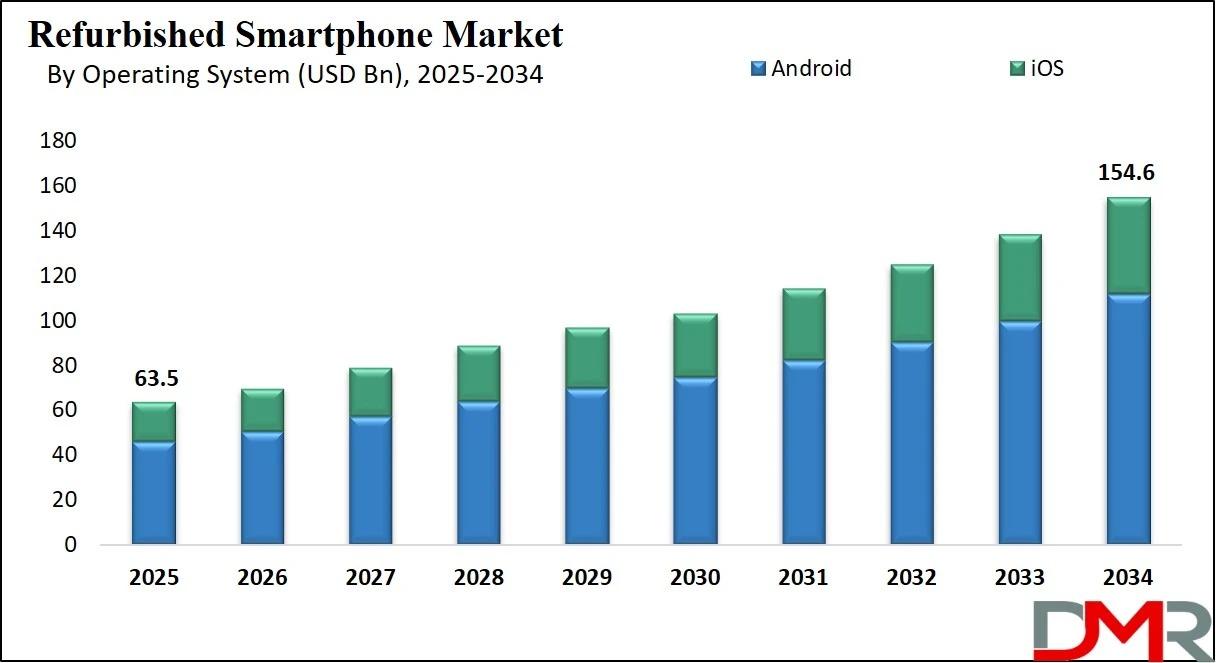
According to Dimension Market Research, the global Refurbished Smartphone Market is projected to reach USD 63.5 billion in 2025 and is expected to grow to USD 154.6 billion by 2034, expanding at a CAGR of 10.4%. This growth is driven by rising demand for affordable smartphones, increased adoption of certified pre-owned devices, and the shift toward sustainable consumer electronics.
A refurbished smartphone is a pre-owned mobile device that has been returned to the manufacturer, retailer, or third-party refurbisher due to defects, trade-ins, or customer dissatisfaction. After undergoing a rigorous inspection, repair, and quality assurance process, these devices are restored to full functionality and resold at a lower price than their brand-new counterparts.
Often, refurbished phones are reconditioned with genuine parts, cleaned, tested for performance, and packaged with a limited warranty. These smartphones offer consumers access to popular models at reduced prices, making them a viable option for budget-conscious users or environmentally conscious buyers seeking sustainable alternatives to new electronics.
The global refurbished smartphone market has experienced significant growth in recent years, driven by growing consumer demand for affordable, high-performance devices and growing environmental awareness. With technological advancements and the saturation of new smartphone sales in mature markets, refurbished devices have emerged as a lucrative segment. E-commerce platforms, trade-in programs, and certified refurbishment services have played a crucial role in expanding access to these devices.
Definition and Market Significance
A refurbished smartphone is a pre-owned mobile device that has undergone professional inspection, testing, repair, and restoration to bring it back to full working condition. These devices are typically sourced from trade-ins, returns, or upgrades and are reconditioned using genuine or high-quality replacement parts before being resold with a warranty.
The significance of the refurbished smartphone market lies in its ability to make advanced mobile technology accessible to price-sensitive consumers while supporting environmental sustainability. By extending the lifecycle of smartphones, the market reduces electronic waste, conserves valuable materials, and promotes circular economy principles.
Refurbished smartphones also support digital inclusion by providing affordable connectivity options for students, first-time buyers, and underserved communities, while offering retailers and OEMs new revenue streams through trade-in and resale programs.
Request a Complimentary PDF Sample
https://dimensionmarketresearch.com/request-sample/refurbished-smartphone-market/
Market Drivers
A major factor driving the Refurbished Smartphone Market is the rising demand for affordable high-end devices. The growing price of flagship smartphones has created a significant demand for affordable alternatives among budget-conscious consumers. Refurbished smartphones offer high-end features, like advanced cameras, OLED displays, and powerful processors, at substantially lower prices. This has fueled demand, especially in emerging markets and price-sensitive regions where access to premium mobile technology was previously limited.
Environmental concerns and e-waste reduction initiatives are another key driver supporting market expansion. As awareness grows around the environmental impact of electronic waste, more consumers and businesses are turning to sustainable electronics. Purchasing second-hand smartphones extends the device lifecycle, reduces landfill contributions, and supports circular economy models. Regulatory pressures and global sustainability goals are also encouraging manufacturers and retailers to establish refurbishment and buyback programs.
The growing number of trade-in and buyback programs offered by OEMs and telecom operators, along with the rising prices of new flagship models, is also contributing to market growth by increasing the supply of high-quality refurbished devices.
Market Trends
The rise of e-commerce platforms and direct-to-consumer channels is emerging as an important trend in the refurbished smartphone market. The growing popularity of online marketplaces like Amazon Renewed, Back Market, and Flipkart 2GUD has revolutionized how refurbished smartphones are marketed and sold. These platforms provide transparent grading, verified warranties, and customer reviews, improving consumer trust. The shift toward direct-to-consumer sales is streamlining logistics and reducing costs, enabling refurbishers to serve a broader audience at competitive prices.
Another significant trend is the growth of brand-led refurbishment programs. Major OEMs like Apple and Samsung are launching their refurbishment initiatives, offering certified refurbished smartphones directly through official channels. These programs ensure high quality, include warranties, and promote brand loyalty among cost-sensitive buyers. The trend of manufacturers participating in the pre-owned smartphone ecosystem is expected to further legitimize and expand the market globally.
The integration of AI and automation in refurbishment processes is also transforming the market, enabling faster diagnostics, standardized grading, and improved inventory management.
Market Restraints
Despite its strong growth potential, the Refurbished Smartphone Market faces certain limitations. Perceived lack of reliability and trust issues pose significant challenges. Despite growing acceptance, many potential buyers remain skeptical about the quality and longevity of refurbished smartphones. Concerns about hidden defects, battery performance, or outdated software can deter consumers from choosing used or pre-owned devices, especially in markets with low awareness about certified refurbishment standards.
Limited availability of spare parts and OEM support is another significant restraint. One of the biggest challenges in the refurbished smartphone market is the availability of genuine replacement parts, especially for older or discontinued models. Limited access to OEM components can affect the quality of repairs and lead to inconsistent performance. Moreover, some manufacturers do not offer software updates or warranty coverage for refurbished units, reducing their appeal among tech-savvy users and corporate clients.
In addition, the lack of standardized quality grading across vendors contributes to trust barriers and can slow adoption in some markets.
Market Opportunities
Expansion in emerging markets presents significant growth opportunities for the refurbished smartphone market. Developing economies in regions such as Africa, Southeast Asia, and Latin America present a major growth opportunity. With rising mobile penetration and limited purchasing power, pre-owned smartphones can bridge the digital divide by offering affordable connectivity. Localized refurbishment centers and tailored marketing strategies can help tap into these untapped regions.
The integration of AI and automation in refurbishment is another promising opportunity. The adoption of AI-powered diagnostics, machine learning-based testing, and automated grading systems offers an opportunity to scale refurbishment operations efficiently. These technologies not only improve refurbishment accuracy but also enhance inventory tracking, quality control, and customer experience. Companies leveraging intelligent repair systems and data analytics are better positioned to dominate the market with faster turnaround times and improved margins.
Furthermore, the growing adoption of refurbished smartphones by enterprises, educational institutions, and government organizations for bulk procurement is expected to open new opportunities for the market.
Segmentation
The Refurbished Smartphone Market is categorized based on type of refurbishment, operating system, price range, age of device before refurbishment, sales channel, and end user.
By type of refurbishment, OEM-certified refurbished smartphones are expected to lead the market in 2025, accounting for approximately 52.0% of the total market share. This dominance is primarily driven by the growing consumer preference for quality assurance, brand trust, and warranty coverage. OEM refurbished models are typically reconditioned by the original manufacturer or through authorized partners using genuine components and standardized testing protocols.
By operating system, Android devices are projected to maintain a strong lead, capturing around 72.0% of the total market share in 2025. This dominance can be attributed to the wide range of Android smartphone brands available globally, which contribute to a large and diverse pool of pre-owned devices entering the secondary market.
By price range, mid-range devices are expected to solidify their dominance, accounting for 48.0% of the total market share in 2025. This category typically includes smartphones priced between USD 200 and USD 500, offering a balanced mix of performance, design, and affordability.
By age of device before refurbishment, smartphones that are 1–2 years old are expected to lead the market in 2025, accounting for 50.0% of the total share. These devices are typically recent-generation models that require minimal repairs and maintain strong hardware and software compatibility.
By sales channel, the online channel is projected to dominate, accounting for 65.0% of the total market share in 2025. The growing popularity of e-commerce platforms has made it easier for consumers to access a wide variety of refurbished smartphone models with transparent pricing, verified quality grades, and warranty options.
By end user, consumers are expected to account for the largest share, capturing approximately 85.0% of the total market in 2025. This dominance is primarily driven by the rising demand for affordable yet feature-rich smartphones among individual buyers.
Regional Analysis
Asia Pacific is projected to lead the global refurbished smartphone market in 2025, accounting for 38.0% of the total global market revenue. This regional dominance is driven by a large population base, high smartphone penetration, and growing demand for affordable mobile devices among price-sensitive consumers. Countries like India, China, Indonesia, and Vietnam are witnessing rapid digital adoption, where refurbished smartphones offer a cost-effective solution for accessing modern technology. The presence of strong e-commerce platforms, widespread trade-in programs, and a growing network of local refurbishers further supports the region's growth.
North America holds a substantial share of the refurbished smartphone market, with the US market projected to reach USD 13.4 billion in 2025 at a CAGR of 9.8%. The market has evolved into a robust and dynamic segment, driven by rising smartphone replacement cycles, cost-conscious consumers, and increased environmental awareness. Major players such as Apple, Amazon Renewed, and Best Buy have enhanced their refurbishment programs, offering thoroughly inspected, tested, and warranty-backed devices.
Europe is a significant market, estimated to be valued at USD 14.0 billion in 2025. This robust position is driven by the region's heightened consumer awareness around sustainability, growing acceptance of circular economy practices, and a mature e-commerce infrastructure. Platforms like Back Market, Swappie, and Refurbed have played a critical role in shaping this behavior by offering professionally refurbished smartphones with warranties and quality assurance. The market is expected to grow at a steady CAGR of 9.5% from 2025 to 2030.
Japan is an emerging market, projected to reach USD 2.9 billion in 2025 at a CAGR of 7.8%. Japan has shown a gradual yet consistent shift toward embracing refurbished mobile devices, driven by the growing popularity of SIM-free smartphones, rising digital adoption among younger and cost-conscious users, and increased awareness of sustainable consumption.
Latin America and the Middle East & Africa are gradually adopting refurbished smartphones as digital infrastructure improves and demand for affordable devices grows, with Brazil, Mexico, Nigeria, and South Africa emerging as key markets. The Middle East and Africa region is expected to witness significant growth over the coming years.
Competitive Landscape
The global competitive landscape of the refurbished smartphone market is characterized by a mix of established OEMs, specialized refurbishing companies, e-commerce giants, and regional players all vying for market share. Leading brands like Apple and Samsung continue to dominate with their certified refurbishment programs, offering high-trust devices with warranties and software support. Meanwhile, platforms like Amazon Renewed, Back Market, and Flipkart (2GUD) have created strong online ecosystems, streamlining the resale process through standardized grading and quality assurance.
Independent refurbishers and startups such as Gazelle, Reboxed, and Cashify are also expanding rapidly, targeting niche segments and regional markets with aggressive pricing and buyback programs. The competition is further intensified by retailers like Best Buy, Walmart, and eBay, which provide accessible refurbished options to mass consumers. As the market matures, differentiation is being driven by quality control, post-sale service, AI-driven diagnostics, and sustainable business models.
Prominent players include Apple Inc., Samsung Electronics, Amazon Renewed, Back Market, Flipkart (2GUD), Gazelle, Reboxed, Paytm Mall, Walmart, Best Buy, Swappa, Refurb.me, FoneGiant, Phone Daddy, TechRefurb, The iOutlet, Togofogo, Cashify, eBay, and Decluttr. Recent developments include Nothing's launch of Phone (3a) and Phone (3a) Pro (May 2025), Swappie's €17 million loan from the European Investment Bank (April 2025), Back Market's partnership with Visible and Bouygues Telecom (October 2024), and Kenyan startup Badili's USD 400K debt facility from Proparco (March 2025).
Technological Advancements
Artificial Intelligence is playing a transformative role in the refurbished smartphone market, reshaping how devices are assessed, repaired, priced, and resold. AI tools can now instantly evaluate key hardware and software functions, such as battery health, camera clarity, touchscreen responsiveness, and internal component wear, reducing human error and ensuring consistent product quality across large volumes of devices.
AI also contributes to dynamic pricing and inventory optimization by analyzing real-time demand, usage trends, and resale value predictions. Machine learning algorithms help refurbishers and e-commerce platforms implement predictive analytics to forecast which models will be in high demand and how pricing should fluctuate to remain competitive. AI-driven grading systems are replacing subjective human inspections, offering more transparent and standardized product listings.
Consumer Adoption Patterns
Consumers, particularly in emerging economies and among cost-sensitive demographics such as students, young professionals, and low-income groups, are increasingly adopting refurbished smartphones to access premium brands and advanced features at significantly lower prices. The availability of certified pre-owned devices with warranty coverage, combined with the convenience of online shopping and attractive financing options, has made refurbished smartphones a popular choice for personal use. Business-to-business procurement by enterprises, educational institutions, and government organizations is also growing steadily.
Regulatory Environment
Government regulations promoting the reduction of electronic waste and encouraging product lifecycle extension significantly influence the refurbished smartphone market. Extended producer responsibility laws, e-waste recycling mandates, and sustainability initiatives across regions are driving the adoption of refurbished devices and supporting the growth of certified refurbishment programs.
Market Challenges
The refurbished smartphone market faces challenges related to perceived lack of reliability, limited availability of genuine spare parts, lack of standardized quality grading, and limited OEM support for older models. Additionally, competition from low-cost new smartphones and the need for continuous investment in diagnostics and quality assurance create ongoing challenges for market participants.
Future Outlook
The future of the Refurbished Smartphone Market remains highly promising as consumer demand for affordable devices and sustainable electronics continues to grow. Increasing adoption of e-commerce platforms, growth of brand-led refurbishment programs, integration of AI in refurbishment processes, and expansion into emerging markets are expected to drive strong market growth during the forecast period, with the market projected to reach USD 154.6 billion by 2034 at a CAGR of 10.4%.
FAQs
What is the expected size of the Refurbished Smartphone Market in 2025?
The market is expected to reach USD 63.5 billion in 2025.
What is the projected market value by 2034?
The market is forecast to reach USD 154.6 billion by 2034.
What is the CAGR of the Refurbished Smartphone Market?
The market is expected to grow at a CAGR of 10.4% during 2025–2034.
Which type of refurbishment dominates the market?
OEM certified refurbished models are expected to dominate with 52.0% share in 2025.
Which region leads the global refurbished smartphone market?
Asia Pacific is projected to lead with 38.0% of total global market revenue in 2025.
Summary of Key Insights
The global Refurbished Smartphone Market is expected to grow from USD 63.5 billion in 2025 to USD 154.6 billion by 2034, recording a CAGR of 10.4% during the forecast period. OEM certified refurbished models lead the type segment with 52.0% share, while Android dominates operating systems with 72.0% share. Mid-range devices lead the price range segment with 48.0% share, and 1–2 year old devices represent 50.0% of the market. Online channels dominate sales with 65.0% share, and consumers account for 85.0% of end-user demand. Asia Pacific holds the largest regional share with 38.0% of global revenue in 2025, while the Middle East & Africa is projected as the fastest-growing region. The US market is projected to reach USD 30.9 billion by 2034 at a CAGR of 9.8%.
Purchase the Full Report
https://dimensionmarketresearch.com/checkout/refurbished-smartphone-market/
