


How Should Motorcycle Racing Gloves Fit? A Track-Ready Sizing and Break-In Guide
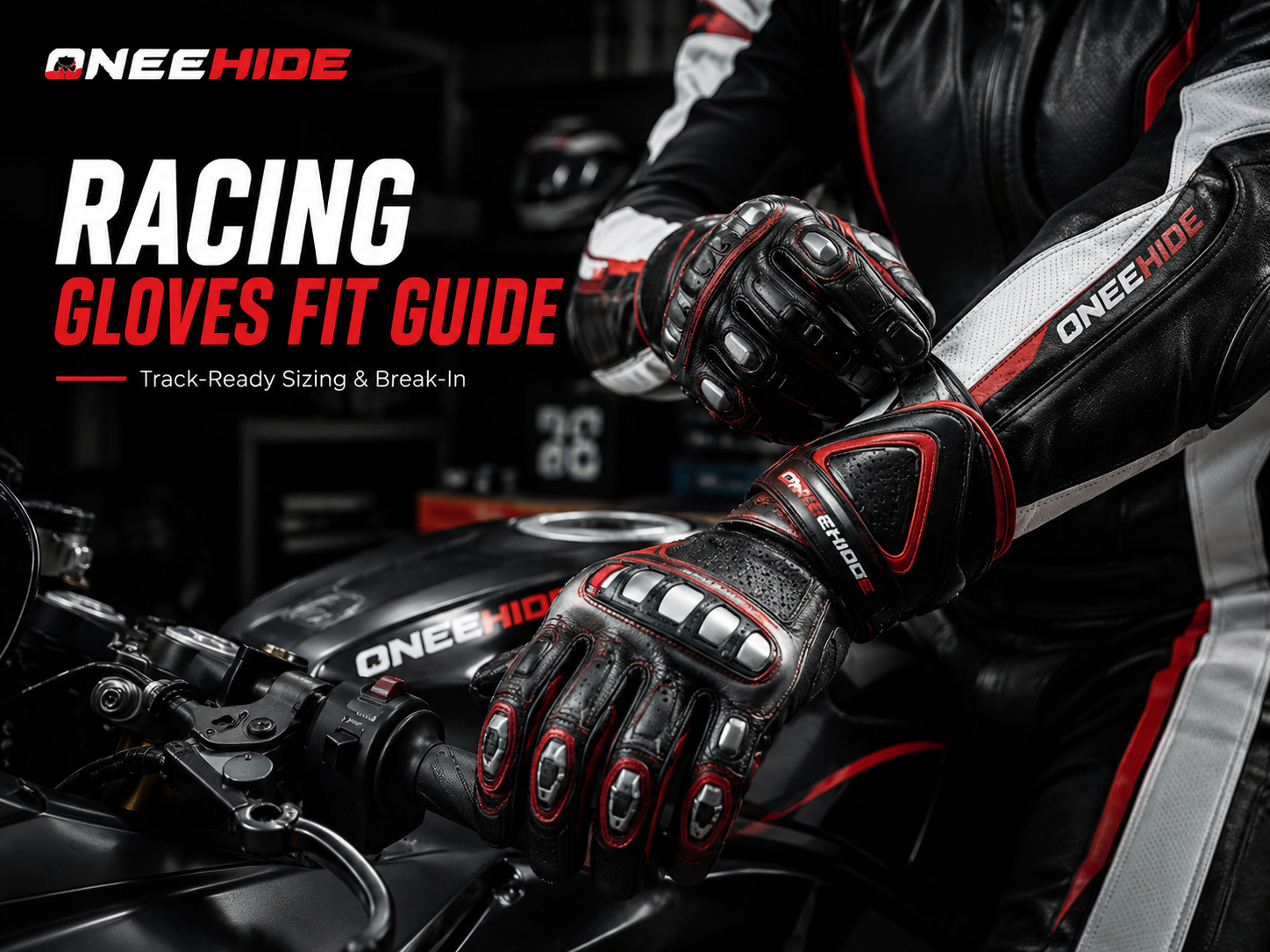
Motorcycle racing gloves should feel snug, secure, and close to the hand without creating painful pressure points or restricting movement. Your fingertips should reach close to the ends of the glove fingers, the palm should stay relatively smooth when gripping the bars, and the glove should remain firmly secured at the wrist.
That balance matters more on a racetrack than it does with casual riding gloves. A glove that is too loose can bunch around the palm or move independently of the hand. One that is excessively tight can interfere with finger movement and make normal control inputs uncomfortable.
The goal is not simply to find the smallest glove you can put on. It is to find a race-oriented fit that stays stable while allowing you to operate the throttle, front brake, clutch, and switches naturally.
What Should a Properly Fitted Racing Glove Feel Like?
A new racing glove will normally feel closer and more structured than a casual street glove. Leather, protective knuckle structures, palm reinforcement, finger protection, and a secure cuff can make the first fitting feel noticeably firmer.
When comparing sizes or trying products such as ONEEHIDE racing gloves, judge the fit with your hand in a riding position rather than simply standing with your fingers straight.
A suitable track fit should generally meet these checks:
-
Your fingertips come close to the ends without being compressed against them.
-
You can make a fist without sharp pressure across the knuckles.
-
The palm does not form large folds when you wrap your hand around a grip.
-
The thumb can move through its normal operating range.
-
Protective sections remain aligned with the knuckles and palm.
-
The wrist restraint can be tightened securely.
-
The cuff works with your racing suit without leaving an exposed gap.
-
You can operate the brake and clutch independently without fighting the glove.
A little resistance from a new leather glove is different from actual restriction. If bending your fingers causes pain, numbness, strong pulling at the fingertips, or excessive pressure from the knuckle protector, the glove may be too small or simply the wrong shape for your hand.
Why Racing Glove Fit Is a Safety Issue, Not Just a Comfort Issue
Protective motorcycle gloves are designed as complete systems. Leather or textile layers, seams, restraint systems, impact protection, cuffs, and other components need to remain where they were intended during riding and, importantly, during an accident.
The European EN 13594:2015 standard illustrates how closely glove construction and retention are connected. SATRA's explanation of EN 13594:2015 notes that the standard specifies two performance levels. Level 2 provides higher protective performance than Level 1, although the increased protection may come with additional weight or restriction. (Satra)
The same standard includes measurable requirements for retention and cuff length. SATRA reports minimum cuff lengths of 5 mm for Level 1 and 50 mm for Level 2 when measured from the wrist line. The restraint test also uses different extraction-force thresholds, 25 N for Level 1 and 50 N for Level 2. Level 2 gloves must include knuckle impact protection. (Satra)
Those figures are not sizing instructions for your hand, but they demonstrate why a racing glove should not be treated like an ordinary fashion glove. Secure fit, wrist retention, cuff coverage, and protective positioning are part of the protective design.
Professional racing rules provide another useful reference point. The 2026 FIM Grand Prix regulations require gloves to have suitable knuckle protection, a fastening system that secures the glove to the hand, and a cuff long enough to overlap the leather suit by at least 50 mm. The regulations also allow EN 13594 Level 2 gloves. The current FIM Grand Prix regulations provide the detailed equipment requirements. (FIM)
You do not need MotoGP equipment rules to choose gloves for an ordinary track day, but the principles are useful: secure retention and continuous coverage matter.
How to Measure Your Hands for Motorcycle Racing Gloves
Do not choose racing gloves from your usual casual glove size alone. Glove sizing systems vary between manufacturers, and hand shape can matter just as much as the letter printed on the label.
Measure Palm Circumference Correctly
Many motorcycle glove size charts use circumference around the palm. A flexible measuring tape is the easiest tool.
Wrap the tape around the widest portion of your palm near the knuckles while excluding your thumb. Keep your hand relaxed and the tape snug rather than pulling it tightly into the skin.
Dainese, for example, specifies palm circumference measured just below the knuckles for selecting its motorcycle glove sizes. Its men's chart progresses through measurements such as 20.3 cm for S, 21.6 cm for M, 22.9 cm for L, and 24.1 cm for XL. These numbers apply to that manufacturer's sizing system, not to every motorcycle glove. Dainese's motorcycle glove sizing information illustrates why checking the specific brand chart matters. (Dainese)
Check Hand Length and Both Hands
Some brands also use hand length or width.
To measure hand length, extend your hand naturally and measure from the base of the palm at the wrist to the tip of the middle finger. If the manufacturer asks for width, measure across the broadest part of the palm without including the thumb.
Measure both hands. Minor left-to-right differences are normal, and the larger measurement is generally the safer reference when comparing the measurements with a manufacturer's chart.
Do not assume that Medium in one racing glove will fit exactly like Medium from another brand.
Test the Gloves in an Actual Riding Position
One of the most common sizing mistakes is evaluating gloves only while standing with the hand open.
A racing glove is used with your fingers curved around handlebars.
Put the gloves on, secure both wrist and cuff closures, then sit on the motorcycle if possible. With the engine off, move through the controls you use on track.
Check all of the following:
-
Close your hand normally around the throttle.
-
Rotate the throttle through its usable range.
-
Cover and squeeze the front brake.
-
Operate the clutch repeatedly.
-
Move individual fingers without opening your entire hand.
-
Turn the handlebars from side to side.
-
Flex and extend your wrist.
-
Hold a typical tucked riding posture for several minutes.
Pay particular attention to the palm. Excess material that seems harmless with an open hand may gather against the grip once your fingers curl.
The opposite problem is excessive tension. If reaching the brake lever pulls strongly across the back of the hand or forces your fingertips against the ends of the glove, the fit needs another look.
How Can You Tell if Racing Gloves Are Too Tight?
A race glove can be snug without being too tight. The distinction becomes clearer once you flex your hand.
Warning Signs of an Undersized Glove
Consider moving up a size or trying a different glove shape if:
-
Your fingertips are constantly pressed hard against the ends.
-
Your fingers cannot fully curl around the grip.
-
The glove creates numbness or tingling.
-
Seams produce concentrated pressure along the fingers.
-
The knuckle protector presses painfully when you make a fist.
-
The thumb feels pulled backward or restricted.
-
Operating the brake or clutch requires noticeably more effort because of glove tension.
-
The wrist closure barely reaches its intended fastening position.
Do not choose an obviously undersized glove because you expect the leather to solve every problem during break-in.
Leather can soften and conform with use, but incorrect finger length, misplaced armor, or severe pressure points are sizing problems rather than normal new-glove stiffness.
How Can You Tell if Racing Gloves Are Too Loose?
Loose racing gloves create a different set of problems.
Warning Signs of an Oversized Glove
Look for:
-
Empty space beyond the fingertips.
-
Material folding under the palm while gripping the bar.
-
The glove rotating around your hand.
-
Knuckle protection moving away from the knuckles.
-
Difficulty making precise control inputs because the glove moves before your hand does.
-
A wrist area that still feels loose after the restraint is correctly tightened.
-
Finger material catching or folding around levers.
A small amount of room is not automatically wrong, especially when comparing different hand shapes, but the glove should move with your hand rather than around it.
Finger length deserves particular attention. A rider with a broad palm and shorter fingers may find a glove that fits correctly around the hand but leaves too much length at the fingertips. Another rider may have the opposite problem. Changing brands or glove patterns may solve the issue better than repeatedly moving up or down in size.
How Much Will Leather Racing Gloves Break In?
Leather racing gloves usually become more compliant as they are worn. Areas around the fingers, palm, and flex zones begin adapting to repeated hand movement.
That does not mean a new glove should be painfully tight.
Break-in should refine an already suitable fit, not rescue the wrong size.
RevZilla's glove fitting guidance also recommends checking new gloves on the motorcycle for binding, bunching, and pinching rather than judging them only from their initial feel. Its motorcycle glove sizing guide emphasizes using the controls as part of the fit assessment. (RevZilla)
A Controlled Break-In Process
Start by wearing the gloves indoors for short periods. Make a fist, flex individual fingers, and repeatedly form the hand position you use on the handlebars.
Then progress to stationary motorcycle checks. Spend time on the throttle, brake, and clutch so the leather begins flexing along the same lines it will experience during riding.
After that, use the gloves during shorter riding sessions before relying on them for a long or demanding track session.
During break-in, watch whether initial pressure becomes more comfortable. Persistent numbness, painful fingertips, severe knuckle pressure, or continued restriction suggests a fit issue rather than ordinary stiffness.
Avoid aggressive shortcuts such as soaking leather gloves, applying uncontrolled heat, or forcefully stretching them. Dainese and Alpinestars product-care guidance recommends allowing motorcycle gloves to dry naturally rather than exposing them to direct heat. (Alpinestars SpA)
Pay Attention to Knuckle Protectors, Palm Sliders, and Seams
Sizing measurements tell you whether a glove is approximately appropriate. Protective-component alignment tells you whether the particular glove shape actually works for your hand.
Close your fist and look at the knuckle protector. It should cover the intended knuckle area without creating a hard pressure point.
Next, examine the palm and outer edge of the hand. Reinforced sections or sliders should follow the hand naturally rather than digging into the palm when you grip the motorcycle.
Modern race gloves may include several protective structures. For example, current racing models can combine reinforced palms, finger-joint protection, hard knuckle components, wrist restraints, and outer-hand protection. These features make precise fit more important because the glove contains relatively rigid elements alongside flexible leather. (Dainese)
Also feel the seams. A seam that lightly touches the hand may become less noticeable after use. A seam that creates sharp, concentrated pressure every time you bend a finger deserves more attention.
Check the Gauntlet With Your Racing Suit
A track glove should be evaluated together with the suit or jacket you plan to wear.
Put both items on and fully secure them. Make sure the gauntlet provides continuous coverage around the wrist area and that the two garments do not interfere with each other's closures.
A cuff can technically be long enough yet still create problems if it is too narrow to fit comfortably around your suit sleeve. An excessively bulky combination can also restrict wrist movement.
After fastening everything, move your wrist through the riding position again. You should not have to loosen the glove until its retention becomes ineffective simply to accommodate the sleeve.
The FIM's 50 mm overlap requirement for Grand Prix gloves and leather suits provides useful context for how seriously high-level racing treats this area of coverage. (FIM)
Should You Size Up if You Are Between Two Sizes?
Not automatically.
If you fall directly between sizes on the manufacturer's chart, consider what is causing the uncertainty.
If the smaller glove fits your palm but compresses your fingertips, sizing up may help. If the larger glove creates folds across the palm or allows the hand to move inside it, a different glove pattern may be a better answer.
Protection should not require sacrificing normal control.
A slightly close-fitting leather glove that allows unrestricted lever operation may settle comfortably after use. A glove that already has substantial palm bunching or excess finger length when new is unlikely to become smaller during break-in.
This is also why size charts should be treated as starting points rather than guarantees.
When Should You Exchange the Gloves Instead of Breaking Them In?
Some new-glove stiffness is normal. Clear sizing problems should not be ignored.
Consider exchanging the gloves before riding extensively if you experience persistent:
-
Fingertip compression
-
Numbness or tingling
-
Pain from the knuckle protector
-
Inability to comfortably make a fist
-
Excess material folding beneath the palm
-
Significant empty fingertip space
-
Protector misalignment
-
Wrist looseness after fastening
-
Restricted throttle, brake, or clutch operation
A track-ready racing glove should feel secure enough that you rarely think about it once riding begins. Your attention belongs on braking markers, body position, throttle application, and the riders around you, not on a seam cutting into your finger or excess leather moving around the grip.
Choose the size from the manufacturer's measurements, verify the shape against your actual hand, test it on the motorcycle, and allow only reasonable leather stiffness to break in. If the glove remains secure, keeps its protective structures correctly positioned, and lets you operate every control naturally, you have found the fit a racing glove is supposed to provide.
