


Why X-Ray Baggage Scanners Are Essential for Airport Security
Airports today handle more passengers, more luggage, and more security risks than ever before. With global air travel continuing to grow, keeping every terminal safe requires more than trained personnel and visible checkpoints. X-Ray Baggage Scanners have become one of the most critical tools in this effort, allowing security teams to look inside bags and containers without ever opening them. In this article, we'll explore why this technology matters so much, how it works, and what airport authorities should look for when choosing the right screening solution.
Why Airport Security Requires Advanced Screening
Passenger traffic at airports has gradually increased over the last decade, as has the number of checked and carry-on baggage traveling through security checkpoints each day. Manual examination alone cannot keep up with the scale.
At the same time, security risks have become increasingly complex. Prohibited objects are occasionally hidden in ways that are difficult to detect with eye inspection or manual searches alone.
This is why quick, accurate luggage inspection is so important. Delays at security checkpoints don't just upset travelers; they can also create pressure, resulting in rushed, less comprehensive screening, increasing the likelihood of anything being overlooked.
Airports require systems designed for speed and precision, capable of conducting continuous, high-volume operations without sacrificing accuracy. This increased demand has prompted established X-ray baggage scanner manufacturers in India to create equipment that is specifically tailored to the size and conditions of regional and international airports.
What Are X-Ray Baggage Scanners?
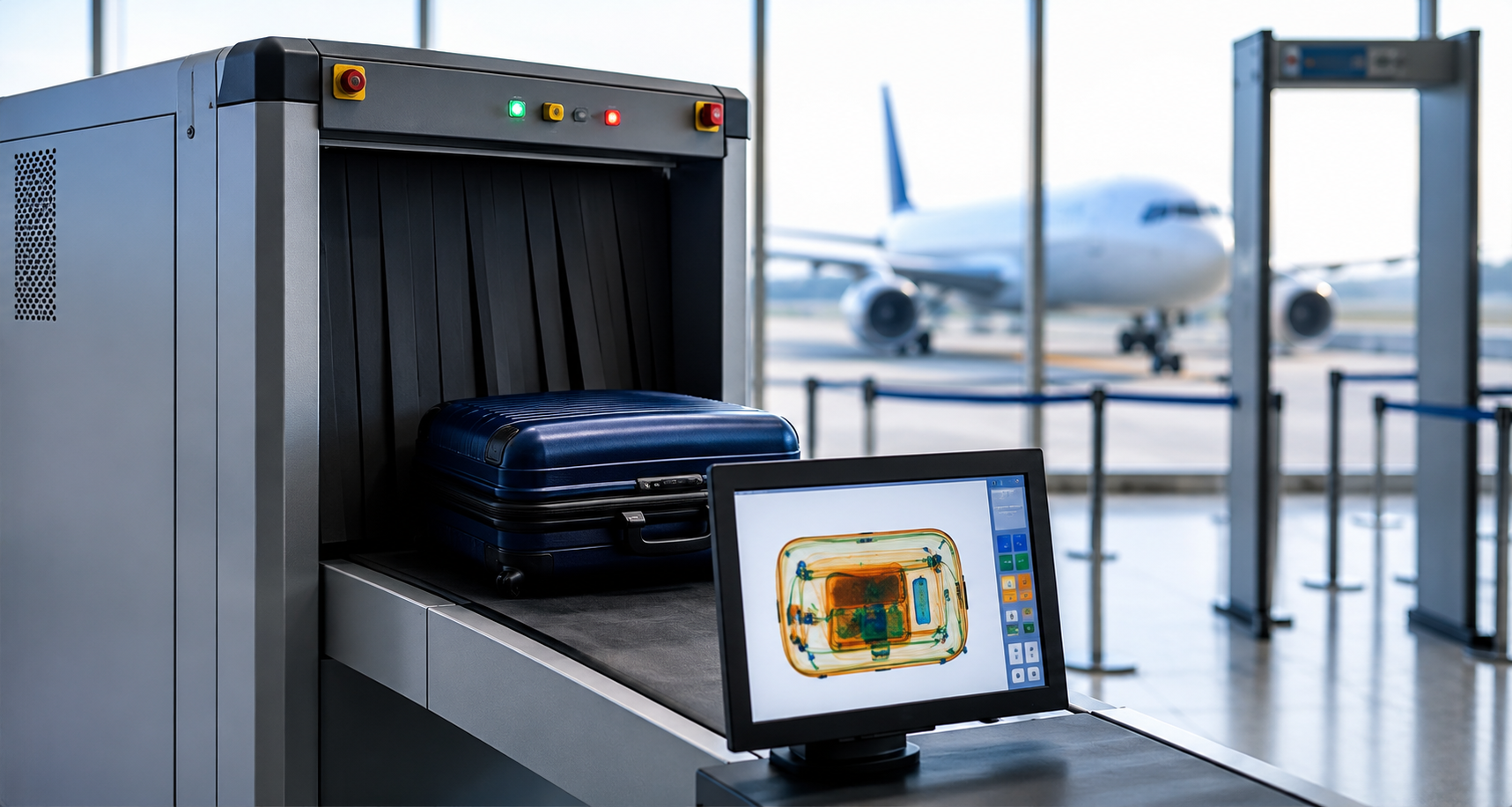
X-ray baggage scanners use regulated X-ray beams to pass through luggage and produce a detailed inside image without opening the bag.
The core components typically include:
- An X-ray generator produces the beam.
- A tunnel through which baggage moves on a conveyor.
- Detectors that collect the X-rays after passing through the item.
- A monitor on which security personnel see the produced image.
Different materials absorb X-rays differently. Metals appear darker and denser on screen, whereas organic objects like clothing and food appear lighter. This contrast enables expert operators to immediately detect strange forms, densities, or concealed chambers that require further investigation.
Why X-Ray Baggage Scanners Are Essential for Airport Security
Detecting Weapons, Explosives, and Prohibited Items
The most obvious advantage is the capacity to detect concealed guns, explosives, and other forbidden goods before they reach a boarding gate.
Improving Passenger Safety
The most obvious advantage is the capacity to detect concealed guns, explosives, and other forbidden goods before they reach a boarding gate.
Faster Baggage Screening
Automated scanning is substantially faster than manual scans, allowing airports to handle large passenger volumes without long security lines.
Reducing Manual Inspections
Scanners reduce the number of manual searches required by highlighting only bags that require closer inspection, saving both passengers and staff time.
Enhancing Operational Efficiency
Streamlined screening keeps passengers moving, eliminating congestion during peak travel times and boosting overall airport operations.
Supporting Regulatory Compliance
Standards for baggage screening are mandated by aviation authorities around the world. Reliable scanning equipment allows airports to achieve these regulatory criteria regularly.
Improving Security Personnel Decision-Making
Clear, high-resolution photographs provide security personnel with the visual information required to make faster, more confident decisions.
Minimizing Human Error
Automated detection features provide a secondary layer of verification, lowering the likelihood of a forbidden item being overlooked during a busy shift.
The Role of AI in Modern Airport Security
Artificial intelligence is altering the way baggage screening works. Rather than depending exclusively on a human operator's judgment, an AI X-ray baggage scanner may detect suspicious forms, densities, or patterns in an image.
This brings several advantages:
- Automatic threat detection: Artificial intelligence systems are trained to recognize the visual signatures of guns, explosives, and other banned goods.
- Faster identification: Suspicious objects are indicated nearly immediately, reducing the time operators spend studying each image.
- Reduced false alarms: Better pattern recognition results in fewer needless bag checks, which enhances the passenger experience while maintaining safety.
- Future of intelligent screening: As machine learning models improve, airports should expect higher accuracy and faster processing in the coming years.
Key Features to Look for in a Baggage Screening System
Not every scanner provides the same level of performance. When evaluating equipment, airport officials and procurement teams should consider:
- High-resolution imaging: Clearer images make it easier to spot little or well-hidden objects.
- Dual-energy imaging: Allows differentiation between organic and inorganic materials for more accurate assessment.
- Organic and inorganic material discrimination: Allows operators to discern between harmless things and potential hazards swiftly.
- Automatic danger recognition: Built-in software that indicates potentially banned objects without requiring operator evaluation.
- Remote monitoring: Enables supervisors to oversee multiple screening points from a central location.
- User-friendly interface: Minimizes training time and operator fatigue during lengthy shifts.
- Reliable conveyor system: Maintains a smooth, continuous baggage flow without regular breakdowns.
- Low maintenance: Reduces downtime while keeping screening lanes functioning.
Choosing the Right Security Solution
Choosing the best scanner is about more than simply the specifications on paper. Airports must address various practical factors:
| Factor Why | Why It Matters |
|---|---|
| Tunnel size | Must accommodate the range of baggage sizes typically handled |
| Throughput requirements | Determines how many bags can be screened per hour |
| Passenger volume | Higher-traffic airports need higher-capacity systems |
| Installation environment | Space, layout, and power requirements vary by terminal |
| Maintenance support | Reliable service ensures minimal downtime |
| Compliance with aviation standards | Equipment must meet applicable safety and regulatory certifications |
Getting these elements right from the start saves airports money on future renovations and replacements.
Why Choose Krystalvision
Krystalvision delivers industry expertise gained through years of experience in security screening technology. The company's products combine modern imaging technology with dependable, consistent performance in demanding airport conditions.
Manufacturing quality is a top priority, guaranteeing that each system is designed to withstand continued daily operation without frequent failures. Beyond the equipment itself, continual customer support enables airport personnel to get the most out of their screening infrastructure in the long run.
Recognizing that no two airports are the same, this strategy comprises specific solutions customized to diverse terminal sizes, passenger numbers, and operational needs, ranging from rural airports to huge international hubs. This combination of technological depth and adaptability distinguishes a screening service from a hardware seller offering a one-time installation.
Conclusion
Modern airport security relies on more than just trained staff and visible checkpoints; it also relies on dependable, high-performance screening technology that operates discreetly in the background. Baggage scanning equipment is critical to keeping air travel secure, from detecting forbidden items to allowing for faster, more confident decision-making.
Investing in advanced screening technology, such as a proficient airport X-ray baggage scanner, is more than just regulatory compliance. It is about increasing passenger confidence, boosting operational efficiency, and remaining prepared for changing security problems. Airports that prioritize this investment will have safer, smoother operations for many years to come.
Frequently Asked Questions
Q: Why are X-Ray Baggage Scanners important in airports?
Answer: They enable security teams to rapidly and precisely assess the contents of bags without physically opening them, aiding in the detection of forbidden items while maintaining efficient passenger flow through checkpoints.
Q: How do airport baggage scanners work?
Answer: They use X-ray beams to pass through luggage, and detectors capture the resulting image. Different materials absorb X-rays in different ways, allowing operators to discern between harmless objects and potential hazards.
Q: Can airport X-ray scanners detect explosives?
Answer: Yes. Modern scanners, particularly those with dual-energy imaging and automatic threat detection, are intended to detect the density and material signatures often associated with explosives.
Q: Are airport baggage scanners safe for passengers?
Answer: Baggage scanners are designed to screen luggage rather than people, and they adhere to stringent regulatory safety standards. Properly maintained equipment provides no health danger to passengers or airport employees.
Q: What items can X-ray baggage scanners identify?
Answer: They can detect guns, explosives, sharp objects, electronics, and other illegal or strange goods by examining the density, shape, and material composition of the scanned image.
Q: How does AI improve airport baggage screening?
Answer: AI enables the automatic detection of suspicious shapes and patterns, which speeds up processing, reduces false alarms, and helps security personnel make faster, more consistent decisions during peak screening hours.
Q: What factors should airports consider before purchasing a baggage scanner?
Answer: Tunnel size, throughput requirements, passenger volume, installation environment, maintenance support availability, and compliance with applicable aviation and safety regulations are all important factors to consider.
Q: How often should airport baggage scanners be maintained?
Answer: Maintenance plans differ depending on manufacturer and usage level; however, routine inspections, calibration checks, and preventative maintenance are usually advised at regular intervals to guarantee consistent performance. High-traffic airports typically benefit from more frequent inspections to avoid unexpected downtime during peak travel seasons.
Q: What is the difference between single-view and dual-view scanners?
Answer: Single-view scanners catch only one image angle, whereas dual-view devices capture two, giving a more full picture of bag contents and minimizing the possibility of concealed objects being undetected.
